Hosted vs Self-Hosted Ecommerce: Which Platform Setup Is Right for You?
Summarize this post with AI
Table of contents
Choosing an ecommerce platform is not only about features.
It is also about responsibility.
Who manages hosting? Who handles updates? Who fixes security issues? Who maintains performance? Who owns the technical setup when something breaks?
That is where the difference between hosted ecommerce and self-hosted ecommerce matters.
A hosted ecommerce platform gives you a managed system where the platform provider handles much of the technical foundation.
A self-hosted ecommerce platform gives you more control, but also more responsibility for hosting, security, updates, performance, and maintenance.
Neither option is automatically better.
The right choice depends on your business model, technical capacity, budget, customization needs, growth plan, and how much operational complexity you want to manage.
In this guide, I will compare hosted vs self-hosted ecommerce, explain how each model works, show the key differences, and help you decide which setup is right for your business.
Editor’s note: This guide is written for founders, small businesses, DTC brands, ecommerce teams, agencies, marketplace operators, and WordPress or WooCommerce users comparing ecommerce platform setups. The goal is not to declare one model as the winner for everyone. The goal is to help you choose the setup that fits how your business actually operates.
TL;DR: Hosted vs Self-Hosted Ecommerce
Hosted ecommerce is usually better if you want faster setup, managed infrastructure, lower technical maintenance, and an easier way to launch and run your store.
Self-hosted ecommerce is usually better if you want deeper control, more backend flexibility, and have the technical resources to manage hosting, updates, security, and custom development.
Here is the quick version:
|
Area |
Hosted ecommerce |
Self-hosted ecommerce |
|
Hosting |
Managed by the platform provider |
Managed by you or your technical team |
|
Setup |
Usually faster |
Usually slower |
|
Technical maintenance |
Lower |
Higher |
|
Control |
More limited than self-hosted |
Higher control |
|
Security updates |
Mostly handled by the provider |
Your responsibility |
|
Customization |
Easier for standard needs |
Deeper customization possible |
|
Developer dependency |
Lower for most stores |
Higher |
|
Cost predictability |
Often easier to plan |
Can vary based on hosting, development, and maintenance |
|
Best for |
Founders, small businesses, DTC brands, agencies, and teams that want less technical work |
Technical teams, custom projects, and businesses that need deep control |
The practical difference is simple:
Hosted ecommerce lets you focus more on selling. Self-hosted ecommerce gives you more control, but also more technical responsibility.
What Is Hosted Ecommerce?
Hosted ecommerce is an ecommerce setup where the platform provider hosts and maintains the software for you.
You do not need to install ecommerce software on your own server.
You do not need to manage hosting infrastructure.
You do not need to manually update the platform.
Instead, you access the platform through a browser, build your store, manage products, configure payments, set shipping and tax rules, process orders, and run your ecommerce business from a dashboard.
Most hosted ecommerce platforms are also SaaS ecommerce platforms.
SaaS stands for Software as a Service.
That means you use the ecommerce software through the cloud, usually through a subscription or platform-based pricing model.
Common hosted ecommerce platforms include Shopify, BigCommerce, Wix Ecommerce, Squarespace Commerce, Square Online, and FlyCommerce.
Hosted ecommerce usually includes:
|
Area |
What the platform helps manage |
|
Hosting |
Server and infrastructure management |
|
Storefront |
Themes, templates, pages, and storefront customization |
|
Products |
Product listings, categories, variations, and inventory |
|
Checkout |
Cart, checkout flow, and order confirmation |
|
Payments |
Payment gateway connections and payment settings |
|
Shipping |
Shipping rates, delivery rules, and fulfillment settings |
|
Tax |
Tax settings and tax-related workflows |
|
Security |
SSL, platform updates, and security maintenance |
|
Orders |
Order management, refunds, and customer communication |
|
Analytics |
Sales, traffic, and performance reporting |
In simple terms:
Hosted ecommerce gives you a managed ecommerce system, so you do not have to build or maintain the technical foundation yourself.
For a broader guide, read: SaaS Ecommerce Platforms: Meaning, Benefits, and Best Options Compared
What Is Self-Hosted Ecommerce?
Self-hosted ecommerce is an ecommerce setup where you run ecommerce software on your own hosting environment.
You may use open-source ecommerce software, a WordPress plugin, a custom-built platform, or another system that your team hosts and maintains.
With self-hosted ecommerce, you usually have more control over the technical environment.
But you also take on more responsibility.
You or your technical team may need to manage:
- Hosting
- Server configuration
- Software installation
- Platform updates
- Plugin or extension updates
- Security patches
- Performance optimization
- Backups
- Bug fixes
- Custom development
- Integration maintenance
Examples of self-hosted or more technically managed ecommerce setups include WooCommerce, Magento Open Source, PrestaShop, OpenCart, and custom ecommerce builds.
WooCommerce is a common example.
It gives strong flexibility for WordPress users, but the store owner usually needs to manage hosting, WordPress, plugins, updates, security, and performance.
Self-hosted ecommerce can be powerful.
But it is not hands-off.
In simple terms:
Self-hosted ecommerce gives you more control, but you are responsible for more of the technical work.
Hosted vs Self-Hosted Ecommerce: Quick Comparison
|
Comparison point |
Hosted ecommerce |
Self-hosted ecommerce |
|
Setup speed |
Faster for most businesses |
Slower because setup requires hosting and configuration |
|
Hosting |
Included or managed by the provider |
You choose and manage hosting |
|
Maintenance |
Platform provider handles much of it |
You or your team handle it |
|
Updates |
Usually automatic or provider-managed |
Manual or developer-managed |
|
Security |
Platform provider manages core platform security |
You manage security, patches, and hardening |
|
Performance |
Provider manages infrastructure performance |
You optimize performance yourself |
|
Customization |
Easier for standard ecommerce needs |
More flexible for custom requirements |
|
Ownership |
You operate inside the platform’s rules |
More control over infrastructure and code |
|
Cost |
More predictable at the platform level |
Can vary based on hosting, plugins, development, and support |
|
Best fit |
Teams that want less technical work |
Teams that need deep control and have technical resources |
The biggest difference is not only where the store is hosted.
The biggest difference is who carries the technical responsibility.
Hosted, SaaS, Self-Hosted, and Open Source: What Is the Difference?
These terms are often used together, but they do not mean the same thing.
Here is the simple version:
|
Term |
Meaning |
|
Hosted ecommerce |
The platform provider hosts and manages the ecommerce system |
|
SaaS ecommerce |
Cloud-based ecommerce software accessed through a subscription or platform pricing model |
|
Self-hosted ecommerce |
You host and maintain the ecommerce software yourself |
|
Open-source ecommerce |
The source code is available to use, modify, or extend, usually with more technical responsibility |
Hosted ecommerce and SaaS ecommerce often overlap.
For example, Shopify, BigCommerce, and FlyCommerce are hosted SaaS ecommerce platforms.
Self-hosted ecommerce and open-source ecommerce often overlap too.
For example, WooCommerce, Magento Open Source, PrestaShop, and OpenCart can be used in self-hosted setups.
The important question is not only:
Is the platform hosted or self-hosted?
A better question is:
How much technical responsibility do I want to manage?
How Hosted Ecommerce Works
Hosted ecommerce works by giving you access to a managed ecommerce platform through the cloud.
The process usually looks like this:
- Create an account.
- Choose a plan.
- Select a theme or template.
- Customize your storefront.
- Add products.
- Connect payment gateways.
- Configure shipping and tax settings.
- Launch your store.
- Manage orders, customers, marketing, and analytics from the dashboard.
The platform provider manages the technical foundation.
You manage the business layer.
That means you can focus on products, orders, customers, campaigns, and growth instead of server setup, software updates, and plugin maintenance.
Hosted ecommerce is useful because it reduces the number of technical decisions you need to make before launch.
For many founders and small teams, that matters.
The faster you move from setup to selling, the faster you can test the business.
How Self-Hosted Ecommerce Works
Self-hosted ecommerce works by installing or running ecommerce software on a hosting environment that you control.
The process usually looks like this:
- Choose ecommerce software.
- Buy or configure hosting.
- Install the ecommerce platform.
- Set up the database and server environment.
- Configure themes, plugins, or extensions.
- Add products.
- Connect payment gateways.
- Configure shipping and tax rules.
- Set up security, backups, and performance optimization.
- Maintain the store over time.
Self-hosted ecommerce gives you more technical control.
But it also creates more operational responsibility.
You may need developers, hosting support, security tools, performance tools, backup systems, monitoring, and ongoing maintenance.
That can be worth it for businesses with highly specific requirements.
But for beginners, small businesses, and non-technical teams, the workload can become heavy.
Key Differences Between Hosted and Self-Hosted Ecommerce
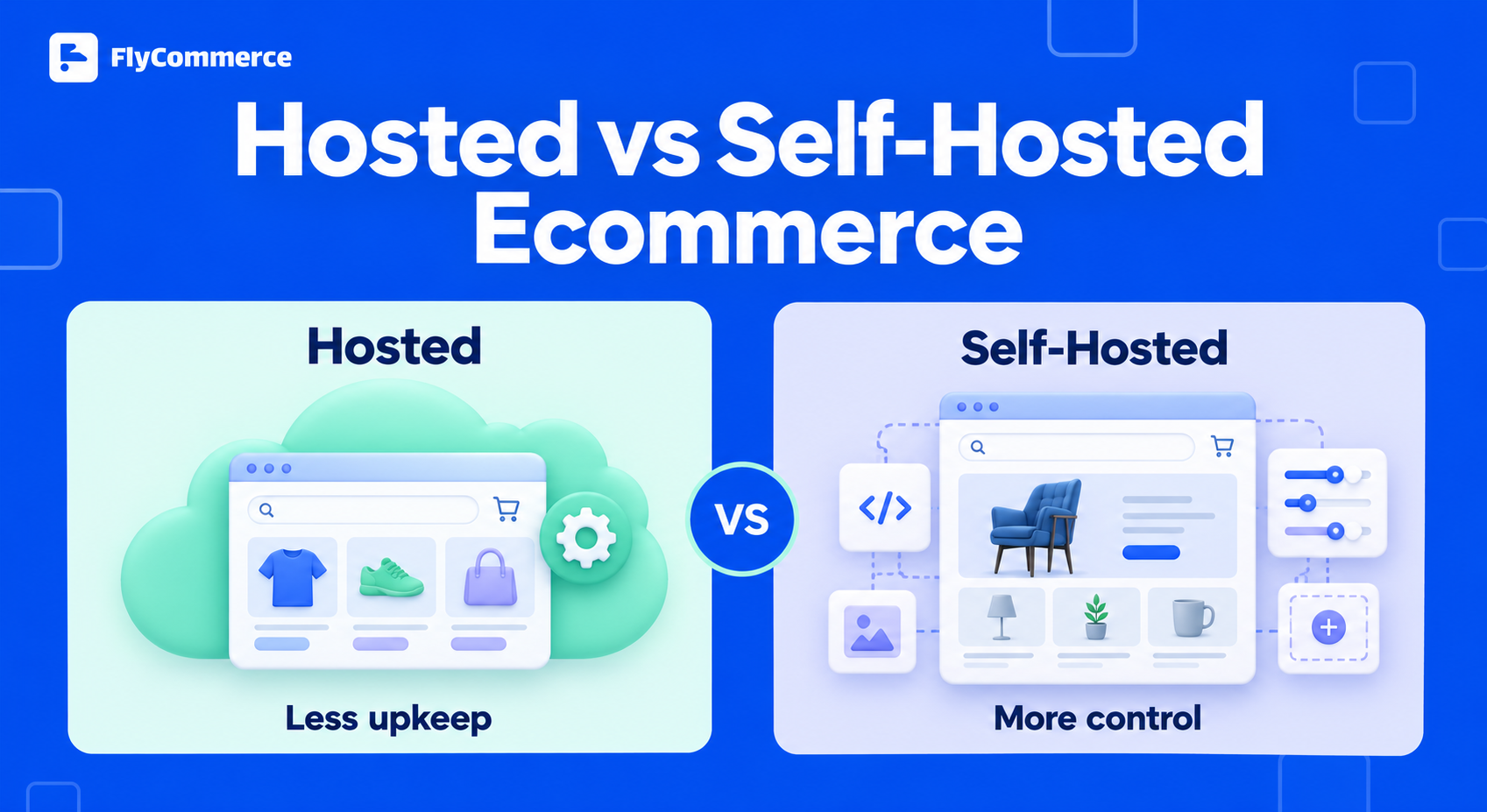
The choice comes down to a few practical differences.
1. Setup Speed
Hosted ecommerce is usually faster to set up.
You can start with a ready platform, choose a theme, add products, connect payments, and launch without building the technical foundation yourself.
Self-hosted ecommerce usually takes longer.
You need hosting, software setup, configuration, theme work, plugin decisions, security settings, performance setup, and ongoing technical support.
Verdict: Hosted ecommerce is better for faster launch. Self-hosted ecommerce is better when setup control matters more than speed.
2. Technical Responsibility
Hosted ecommerce reduces technical responsibility.
The platform provider usually handles hosting, core updates, infrastructure, platform maintenance, and security improvements.
Self-hosted ecommerce puts more responsibility on you.
You need to manage hosting, updates, patches, plugin compatibility, backups, security, and performance.
Verdict: Hosted ecommerce is better for teams without technical resources. Self-hosted ecommerce is better for teams that want technical ownership.
3. Customization and Control
Self-hosted ecommerce usually gives more control.
You can often customize deeper parts of the store, server, codebase, database, and technical environment.
Hosted ecommerce gives enough flexibility for most standard ecommerce needs, but you operate within the platform’s system and rules.
That can limit certain types of backend customization.
Verdict: Self-hosted ecommerce wins on deep control. Hosted ecommerce wins on simplicity.
4. Cost Structure
Hosted ecommerce usually has clearer platform pricing.
You may pay a monthly or yearly subscription, revenue share, transaction fees, payment processing fees, app costs, or enterprise pricing.
Self-hosted ecommerce can look cheaper at first because some software may be free or open source.
But the real cost can include hosting, themes, plugins, security, development, maintenance, bug fixes, backups, and performance work.
The cheapest starting cost is not always the lowest total cost.
Verdict: Hosted ecommerce is often easier to budget. Self-hosted ecommerce can be cost-effective with the right technical resources, but hidden costs can grow.
5. Security and Maintenance
Hosted ecommerce platforms usually manage much of the security and maintenance work.
That can include SSL, infrastructure updates, platform patches, monitoring, and uptime management.
Self-hosted ecommerce requires you to manage more of this yourself.
That includes software updates, plugin updates, server security, malware protection, backups, and recovery plans.
Security mistakes can become expensive.
Verdict: Hosted ecommerce is better for lower maintenance. Self-hosted ecommerce requires stronger security discipline.
6. Scalability
Hosted ecommerce platforms can scale well for many businesses because the provider manages the infrastructure.
As your store grows, you may need to upgrade plans, add integrations, improve operations, and optimize workflows, but you usually do not need to rebuild the hosting layer yourself.
Self-hosted ecommerce can also scale, but scaling depends on your hosting setup, technical architecture, performance work, and development resources.
Verdict: Hosted ecommerce is easier to scale operationally for most growing stores. Self-hosted ecommerce can scale deeply, but needs technical planning.
7. App and Plugin Dependency
Both models can depend on apps, plugins, or extensions.
Hosted ecommerce platforms often have app marketplaces.
Self-hosted platforms often rely on plugins, extensions, custom code, or third-party tools.
The risk is the same in both cases:
Too many add-ons can make your store harder to manage.
They can increase cost, create compatibility issues, slow down performance, or create support problems.
Verdict: Choose the platform that gives you more of your must-have workflows natively, so you do not have to build your business from disconnected tools.
Benefits of Hosted Ecommerce
Hosted ecommerce is popular because it removes technical friction from launching and managing an online business.
Here are the main benefits.
Faster Launch
A hosted ecommerce platform gives you a ready foundation.
You can start with themes, templates, product tools, checkout, payments, shipping, tax settings, and analytics without building the system from zero.
This helps founders and teams move faster.
Lower Technical Maintenance
Hosted ecommerce reduces the need to manage hosting, servers, security patches, and software updates.
That gives business owners more time to focus on selling, customer experience, products, and marketing.
Easier for Non-Technical Teams
Many hosted platforms are built for business users.
You do not need to be a developer to add products, update pages, process orders, run promotions, or check reports.
Developers may still help with advanced customization, but they are not always required for the first version of the store.
More Predictable Platform Foundation
Hosted ecommerce usually gives you a clearer platform foundation.
You know where the store is managed, who handles core updates, and where support comes from.
That makes operations easier for many small and growing teams.
Managed Security and Updates
Security and updates matter in ecommerce because a broken checkout or unsafe store can directly affect revenue.
Hosted platforms usually handle much of the platform-level security and maintenance for you.
Better Focus on Growth
The biggest benefit is focus.
Instead of spending your early stage on technical setup, you can spend more time on products, customers, content, campaigns, conversion, retention, and growth.
Limitations of Hosted Ecommerce
Hosted ecommerce is not perfect.
Before choosing it, understand the trade-offs.
Less Backend Control
Hosted platforms usually give less backend control than self-hosted systems.
For most businesses, this is fine.
But if you need custom infrastructure, deep backend changes, or highly specific workflows, hosted ecommerce may feel limiting.
Platform Rules Matter
With hosted ecommerce, you operate inside the platform’s rules.
That can affect checkout customization, payment options, data handling, app usage, API access, and advanced workflows.
Always check whether the platform supports your business model before committing.
Costs Can Grow With Apps or Usage
Hosted platforms may charge based on subscription, revenue share, transaction fees, staff seats, app usage, payment processing, or enterprise requirements.
The starting price does not always show the full cost.
Migration Can Be Hard Later
Moving from one ecommerce platform to another can be complex.
You may need to migrate products, customers, orders, URLs, SEO data, payment settings, shipping rules, tax settings, integrations, and reporting.
That is why choosing the right hosted platform matters.
Benefits of Self-Hosted Ecommerce
Self-hosted ecommerce is useful when control is more important than simplicity.
Here are the main benefits.
More Technical Control
Self-hosted ecommerce gives you more control over the hosting environment, codebase, database, integrations, and backend behavior.
That can be useful for complex requirements.
More Customization Potential
If your business needs a highly specific workflow, custom frontend, unique checkout flow, custom data structure, or deep integration, self-hosted ecommerce may give more room to build it.
More Ownership of Infrastructure
Some businesses want to own more of the technical stack.
Self-hosted ecommerce can give them more control over hosting, data handling, infrastructure decisions, and technical architecture.
Strong Fit for Technical Teams
If you already have developers, DevOps support, security resources, and ecommerce technical experience, self-hosted ecommerce can be a strong option.
The model works best when the business has the capacity to manage it properly.
Limitations of Self-Hosted Ecommerce
Self-hosted ecommerce can be powerful, but the trade-offs are serious.
More Maintenance Work
You need to manage updates, plugins, hosting, security, backups, and performance.
That work does not stop after launch.
It continues as long as the store exists.
Higher Developer Dependency
Self-hosted stores often need technical help for setup, customization, troubleshooting, optimization, and maintenance.
That can slow down changes if your team does not have technical resources.
More Security Responsibility
You are more responsible for keeping the store secure.
That includes server security, software updates, plugin safety, malware protection, backups, and recovery.
Costs Can Be Unpredictable
Self-hosted software may look affordable at first.
But hosting, plugins, development, maintenance, security tools, performance optimization, and emergency fixes can increase the total cost.
Setup Can Take Longer
A self-hosted ecommerce store often needs more planning before launch.
That can be a problem if your priority is speed.
Hosted vs Self-Hosted Ecommerce Cost Comparison
Cost is one of the biggest reasons people compare hosted and self-hosted ecommerce.
But the real comparison is not just monthly platform price.
You need to compare total cost of ownership.
|
Cost area |
Hosted ecommerce |
Self-hosted ecommerce |
|
Platform fee |
Usually monthly, yearly, or usage-based |
Software may be free, paid, or open source |
|
Hosting |
Usually included |
Paid separately |
|
Security |
Mostly platform-managed |
You manage or pay for it |
|
Updates |
Provider-managed |
You or your developer manage them |
|
Themes |
Free or paid |
Free or paid |
|
Apps/plugins |
May require paid apps |
May require paid plugins or extensions |
|
Development |
Lower for basic setup |
Often higher |
|
Maintenance |
Lower |
Higher |
|
Performance optimization |
Mostly platform-managed |
You manage it |
|
Support |
Comes from platform/provider |
Split between hosting, plugins, developers, and software community |
The key question is:
What will this platform cost after the store is live, growing, and generating real operational needs?
A hosted platform may look more expensive at first but save time on maintenance.
A self-hosted platform may look cheaper at first but cost more in technical support.
For a broader cost breakdown, read: How Much Does an Ecommerce Website Cost?
Which Is Better for Small Businesses?
For most small businesses, hosted ecommerce is usually the better starting point.
Small businesses often need:
- Faster setup
- Lower technical dependency
- Simple product management
- Built-in checkout
- Easy payment setup
- Basic shipping and tax workflows
- SEO tools
- Analytics
- Support
- Predictable operations
Hosted ecommerce fits those needs better because it reduces the amount of technical work required before launch.
Self-hosted ecommerce may still make sense for small businesses that already use WordPress, have technical support, or need deep customization.
But for most small businesses, the practical advantage of hosted ecommerce is clear:
less technical setup, fewer maintenance tasks, and a faster path to selling.
Which Is Better for Growing Brands?
For growing brands, the answer depends on complexity.
Hosted ecommerce is a strong fit if the brand wants to move fast, keep maintenance low, and use a managed platform that can support products, payments, shipping, tax, SEO, analytics, and marketing integrations.
Self-hosted ecommerce may be a better fit if the brand needs deep customization, unique workflows, advanced integrations, or more control over infrastructure.
The decision should be based on the team’s technical capacity.
A growing brand without strong technical resources can slow itself down by choosing self-hosted ecommerce too early.
A growing brand with strong technical resources may benefit from the flexibility of self-hosted ecommerce.
The better question is:
Do we need deeper control, or do we need more speed and operational simplicity?
Which Is Better for Marketplaces?
Marketplaces are more complex than normal online stores.
A marketplace does not only manage products and customers.
It also manages vendors, seller onboarding, product approval, commission rules, vendor dashboards, payouts, seller performance, marketplace reporting, and trust workflows.
That means the hosted vs self-hosted decision becomes more important.
A hosted marketplace platform can help if it includes vendor workflows natively.
A self-hosted marketplace setup can work if you have the technical team to build, customize, and maintain vendor operations.
The mistake is choosing a normal store builder and assuming it will become a marketplace easily.
Marketplace features should not be treated as small add-ons.
They are part of the business model.
For marketplace founders, the key question is:
Does the platform support vendor operations from the start?
Hosted Ecommerce Is Better When
Choose hosted ecommerce if:
- You want to launch faster
- You do not want to manage hosting
- You do not want to manage servers
- You do not want to maintain plugins
- You do not have an in-house technical team
- You want managed updates and infrastructure
- You want easier day-to-day ecommerce operations
- You want a more predictable platform foundation
- You want to focus on products, customers, and growth
- You are building a standard online store or hosted marketplace with supported workflows
Hosted ecommerce is usually the better choice for founders, small businesses, DTC brands, local businesses, agencies, and teams that want less technical overhead.
Self-Hosted Ecommerce Is Better When
Choose self-hosted ecommerce if:
- You need deep backend control
- You want to own more of the technical stack
- You already have technical resources
- You need custom infrastructure
- You need highly specific workflows
- You want code-level flexibility
- You are comfortable managing hosting, updates, and security
- You have developers who can maintain the system
- You need a custom ecommerce experience that hosted platforms cannot support
Self-hosted ecommerce is usually better for technical teams, custom ecommerce projects, and businesses with complex requirements that justify the extra responsibility.
Hosted vs Self-Hosted Ecommerce: Decision Checklist
Use this checklist before choosing.
|
Question |
Choose hosted if |
Choose self-hosted if |
|
How fast do you need to launch? |
You want to launch quickly |
You can spend more time on setup |
|
Do you have developers? |
No or limited technical support |
Yes, you have technical resources |
|
Do you want to manage hosting? |
No |
Yes |
|
Do you need deep backend control? |
No |
Yes |
|
How much maintenance can you handle? |
You want low maintenance |
You can manage ongoing maintenance |
|
Do you need custom infrastructure? |
No |
Yes |
|
Is predictable operation important? |
Yes |
Less important than control |
|
Are you building a marketplace? |
Choose hosted only if marketplace workflows are included |
Choose self-hosted if you can build and maintain vendor workflows |
|
Is SEO important? |
Make sure the hosted platform supports SEO controls |
Make sure your team can manage technical SEO |
|
Is cost predictability important? |
Hosted is usually easier to plan |
Self-hosted can vary more |
|
Do you need full platform ownership? |
Not required |
Yes |
How FlyCommerce Fits Into Hosted Ecommerce
FlyCommerce is a no-code, cloud-hosted SaaS ecommerce platform for businesses that want to build online stores or multi-vendor marketplaces without managing hosting, servers, plugins, or technical maintenance.
It fits the hosted ecommerce model.
That means FlyCommerce manages the technical platform foundation, while businesses manage their ecommerce operations from a browser-based dashboard.
FlyCommerce supports two ecommerce paths:
|
FlyCommerce path |
Best for |
What it helps you build |
|
FlyCommerce Shop |
Store owners, DTC brands, SMBs, first-time sellers, and digital product sellers |
A professional online store |
|
FlyCommerce Marketplace |
Marketplace founders, agencies, B2B teams, and marketplace operators |
A multi-vendor marketplace |
FlyCommerce is useful if you want:
- A hosted ecommerce platform
- No-code storefront building
- No hosting setup
- No plugin maintenance
- Product, order, payment, shipping, tax, SEO, analytics, and reporting workflows
- Online store and marketplace support
- Vendor onboarding, dashboards, commission rules, vendor plans, payouts, and marketplace reporting
- AI support for product content workflows
- A simpler way to launch, sell, and grow from one managed platform
The main value is not only that FlyCommerce helps you build a store.
It helps you avoid building the ecommerce stack piece by piece.
That is especially useful for businesses that want a professional ecommerce setup without managing the technical backend themselves.
To learn more, read: What Is FlyCommerce and How Does It Work?
Final Verdict: Hosted or Self-Hosted Ecommerce?
Hosted ecommerce and self-hosted ecommerce can both work.
But they solve different problems.
Choose hosted ecommerce if you want faster setup, managed infrastructure, lower technical maintenance, and a simpler way to run your ecommerce business.
Choose self-hosted ecommerce if you need deeper control, more customization, and have the technical resources to manage hosting, updates, security, and maintenance.
For most new stores, small businesses, DTC brands, agencies, and non-technical founders, hosted ecommerce is usually the better starting point.
For technical teams and highly custom ecommerce projects, self-hosted ecommerce may be the better fit.
The best choice depends on one question:
Do you want to spend more time managing the technical stack, or more time building the business?
If your answer is building the business, hosted ecommerce is usually the better path.
Related Reading
- SaaS Ecommerce Platforms
- How Much Does an Ecommerce Website Cost?
- What Is FlyCommerce and How Does It Work?
- How to Choose the Right Ecommerce Platform
FAQs About Hosted vs Self-Hosted Ecommerce
What is the difference between hosted and self-hosted ecommerce?
Hosted ecommerce means the platform provider hosts and maintains the ecommerce system for you. Self-hosted ecommerce means you run ecommerce software on your own hosting environment and manage more of the technical setup yourself.
Is Shopify hosted or self-hosted?
Shopify is a hosted ecommerce platform. It hosts the ecommerce software for you and provides tools for storefront design, checkout, payments, products, orders, analytics, and integrations.
Is WooCommerce hosted or self-hosted?
WooCommerce is usually used as a self-hosted ecommerce setup because it runs on WordPress. The store owner usually manages hosting, WordPress, plugins, updates, security, and maintenance.
Is hosted ecommerce better than self-hosted ecommerce?
Hosted ecommerce is better if you want faster setup, lower technical maintenance, and managed infrastructure. Self-hosted ecommerce is better if you need deeper control and have the technical resources to manage the system.
Is self-hosted ecommerce cheaper?
Not always. Self-hosted software may look cheaper at first, but hosting, development, plugins, security, maintenance, backups, and performance optimization can increase the total cost.
Which ecommerce setup is better for beginners?
Hosted ecommerce is usually better for beginners because it reduces technical setup and maintenance work. Beginners can focus more on products, customers, orders, and marketing.
Which ecommerce setup is better for developers?
Self-hosted ecommerce may be better for developers who need code-level control, custom infrastructure, and deep customization. Hosted ecommerce can still work if the platform provides strong APIs and integrations.
Which ecommerce setup is better for small businesses?
Hosted ecommerce is usually better for small businesses because it reduces hosting, server, update, and maintenance work. Self-hosted ecommerce can work for small businesses with technical support or WordPress experience.
Which ecommerce setup is better for marketplaces?
The best setup depends on whether the platform supports vendor workflows. A hosted marketplace platform can work well if vendor onboarding, dashboards, commissions, payouts, and reporting are built in. A self-hosted marketplace can work if you have the technical team to build and maintain those workflows.
What are examples of hosted ecommerce platforms?
Examples include FlyCommerce, Shopify, BigCommerce, Wix Ecommerce, Squarespace Commerce, and Square Online.
What are examples of self-hosted ecommerce platforms?
Examples include WooCommerce, Magento Open Source, PrestaShop, OpenCart, and custom ecommerce builds.
Is FlyCommerce a hosted ecommerce platform?
Yes. FlyCommerce is a no-code, cloud-hosted SaaS ecommerce platform for building online stores and multi-vendor marketplaces without managing hosting, servers, plugins, or ecommerce infrastructure yourself.
FlyCommerce is a no-code, SaaS-based multi-vendor platform featuring a drag-and-drop builder to launch and scale global marketplaces without technical expertise.
The Fastest Way to Build Your Store or Marketplace
Everything you need to get your online store or marketplace up and running. Just follow four simple steps and start selling with FlyCommerce.
Start a 14-day free trial

Written by
Mamunur Rahsid
Md. Mamunur Rahsid is Senior Digital Marketing Strategist (Acting Manager) at weDevs, leading marketing and growth initiatives for FlyWP, FlyCommerce and collaborating on other products. With over 11 years of experience, he specializes in SEO, media buying, video marketing, email marketing, and growth-hacking strategies. Competitor analysis is one of his core strengths, and he is passionate about creating data-driven strategies that optimize user journeys and drive impactful growth.
Outside of work, he enjoys exploring the latest marketing trends, learning about new technologies, and spending quality time with family and friends.