14 Types of Ecommerce Business Models With Examples

Mamunur Rahsid
11–17 minutes
Human Written
Choosing an ecommerce business model is not only about deciding what to sell. The harder question comes after: who is actually buying it, and how does the product get from you to them without either side losing money on the way.
That is why the businesses that get this wrong don’t usually fail because of a bad product. They fail because they answered only half the question. B2C, B2B, dropshipping, subscription, marketplace: these are not one decision, they are two separate ones stacked on top of each other, and most guides on this topic only walk through one layer.
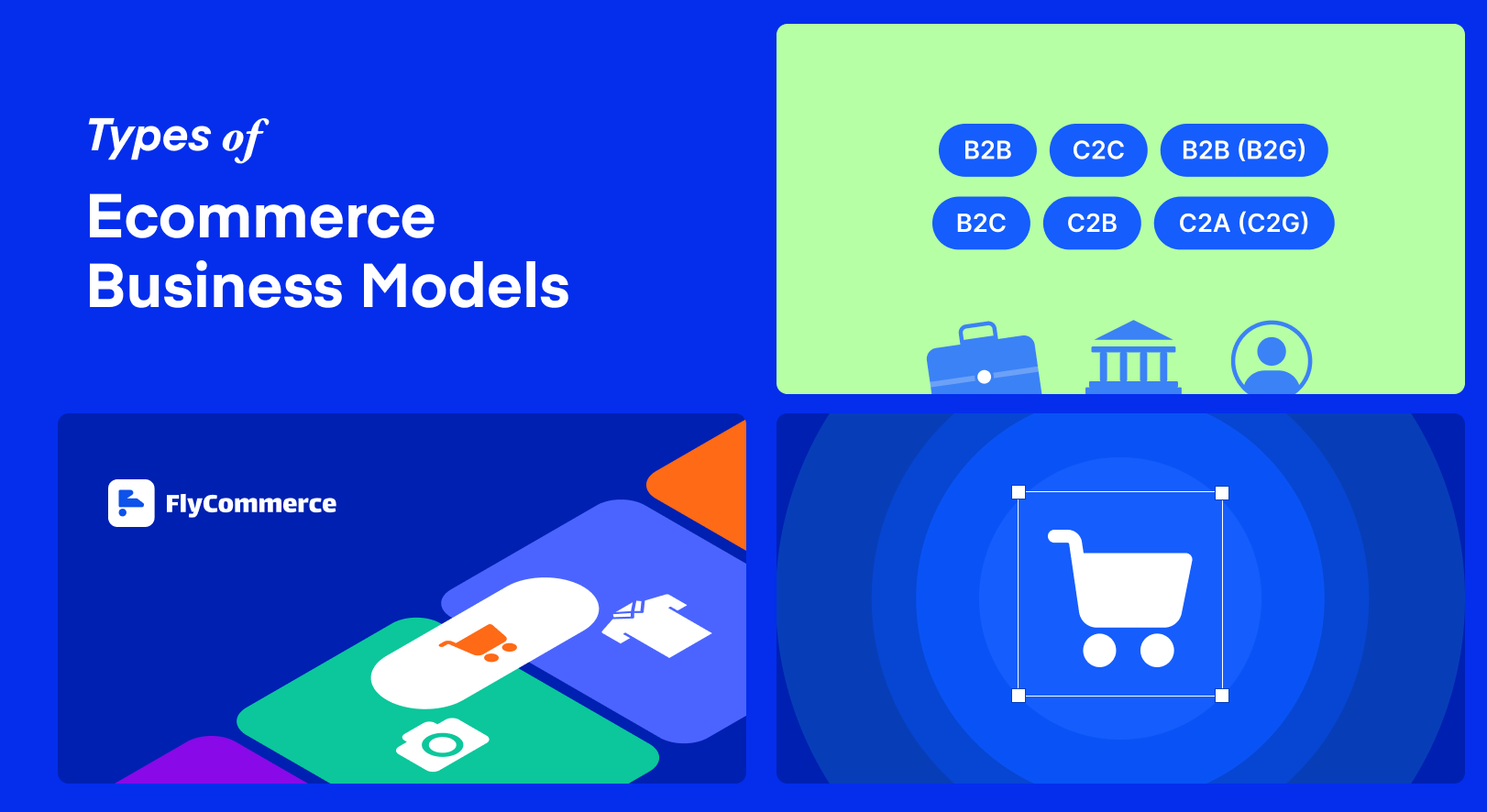
In this guide, I break down ecommerce business models across both layers: who you sell to (B2C, B2B, D2C, C2C, C2B, B2B2C, B2G) and how you source, fulfill, and get paid (DTC, dropshipping, private label, wholesale, subscription, digital products, marketplace), with real margin data and a straightforward way to decide between them.
TL;DR:
The best ecommerce business model depends on two separate decisions: who you’re selling to, and how you source and fulfill the product. There is no single best answer across both layers at once.
For margin, private label and DTC typically perform best, often 30% to 50%, because you own the brand and keep the full markup. For speed to test an idea, dropshipping wins, with the lowest startup cost but the thinnest margins, usually 10% to 20%. For predictable recurring revenue, subscription is the strongest layer. For building a platform rather than a product line, marketplace is the only model built for that job.
If you want one simple rule, use this:
- Choose dropshipping if you have little capital and want to validate demand fast.
- Choose private label or DTC if you have a product idea and want to build a real brand.
- Choose wholesale alongside DTC if you already manufacture or make something.
- Choose subscription if your product is something people reorder naturally.
- Choose marketplace if you want to build a platform other sellers operate through, not a product line of your own.
What Is an Ecommerce Business Model?
An ecommerce business model is the structure that defines who you sell to, how you source or make what you sell, and how money moves through the business as a result.
It answers three questions at once: what are you selling, who is buying it, and how do you get paid.
Most people confuse the business model with the revenue model. They are not the same thing. The business model is the full structure: your target buyer, your fulfillment approach, and your growth path. The revenue model is narrower. It describes only the pricing mechanic: commission, subscription, one-time sale, or markup. A marketplace and a subscription box can both use a commission-based revenue model, but they are completely different business models.
Getting this distinction right matters because two businesses can share a revenue model and still fail for opposite reasons. A subscription box with the wrong customer relationship layer (selling B2C instead of B2B, for instance) will churn for reasons that have nothing to do with the subscription pricing itself.
The Two Ways to Classify Ecommerce Business Models
Ecommerce business models split along two independent layers, and most founders only think about one of them.
The first layer is the customer relationship: are you selling to individual consumers, other businesses, or a mix of both? This changes your average order value, your sales cycle, and how you market.
The second layer is fulfillment and revenue: do you hold inventory, make the product yourself, pass orders to a supplier, or build a platform for other people to sell through? This is where your margin actually lives.
You need an answer on both layers before you build anything. A store can be B2C and dropshipping. Another can be B2C and private label. Same customer, completely different cost structure and ceiling.
| Layer | What it defines | Models covered |
|---|---|---|
| Customer relationship | Who you sell to | B2C, B2B, D2C, C2C, C2B, B2B2C, B2G |
| Fulfillment and revenue | How you source, deliver, and get paid | DTC, dropshipping, private label, wholesale, subscription, digital products, marketplace |
Types of Ecommerce by Customer Relationship
This is the layer most people think of first. It defines who is on the other side of the transaction.
1. B2C (Business to Consumer)
A business sells directly to individual consumers who use the product for personal use. This is the most common ecommerce model by transaction volume and what most people picture when they think of an online store. Order values are typically smaller, buying decisions happen fast, and volume matters more than any single sale.
Example: Amazon, Target, and most fashion or electronics retailers selling to individual shoppers.
2. B2B (Business to Business)
A business sells to other businesses rather than individual consumers. Order values are larger, sales cycles are longer, and pricing is often negotiated or tiered instead of fixed. B2B ecommerce is larger than B2C by total transaction value globally, even though it gets far less public attention.
Example: Alibaba connecting manufacturers with retailers, or a software company like Slack selling subscriptions to companies rather than individuals.
3. D2C (Direct to Consumer)
A brand or manufacturer sells straight to the end customer, skipping distributors and retailers entirely. The brand keeps full control over pricing, branding, and the customer relationship, along with the full margin. The tradeoff is that the brand has to drive all of its own traffic instead of borrowing an existing audience.
Example: Warby Parker and Allbirds both built their business by selling direct instead of through retail partners.
4. C2C (Consumer to Consumer)
Individuals sell directly to other individuals through a platform that facilitates the transaction, handles payment, and manages trust between strangers. Items are typically second-hand, though new items appear too. The platform earns a commission for hosting the transaction.
Example: eBay, Poshmark, and Facebook Marketplace all run on the C2C model.
5. C2B (Consumer to Business)
An individual provides a product or service to a business, which flips the usual direction of the transaction. This is common in freelance and creative work, where the individual sets the terms and the business pays for the output.
Example: A freelance designer selling services through Upwork or Fiverr, or a photographer licensing stock images through a platform that pays them per download.
6. B2B2C (Business to Business to Consumer)
A business sells its product to another business, which then resells it to the end consumer. The end consumer typically knows who the original brand is, even though a middle business handled the resale. This model is common in wholesale and white-label distribution arrangements.
Example: A skincare brand selling wholesale to a retailer, who then sells the same product to shoppers under its own storefront.
7. B2G (Business to Government)
A business sells products or services to government agencies rather than private companies or individuals. These transactions usually involve contracts, tenders, and stricter compliance requirements than commercial sales.
Example: A cybersecurity vendor selling threat detection software to a government agency, or an IT company providing cloud infrastructure to a public sector client.
Types of Ecommerce by Fulfillment and Revenue Model
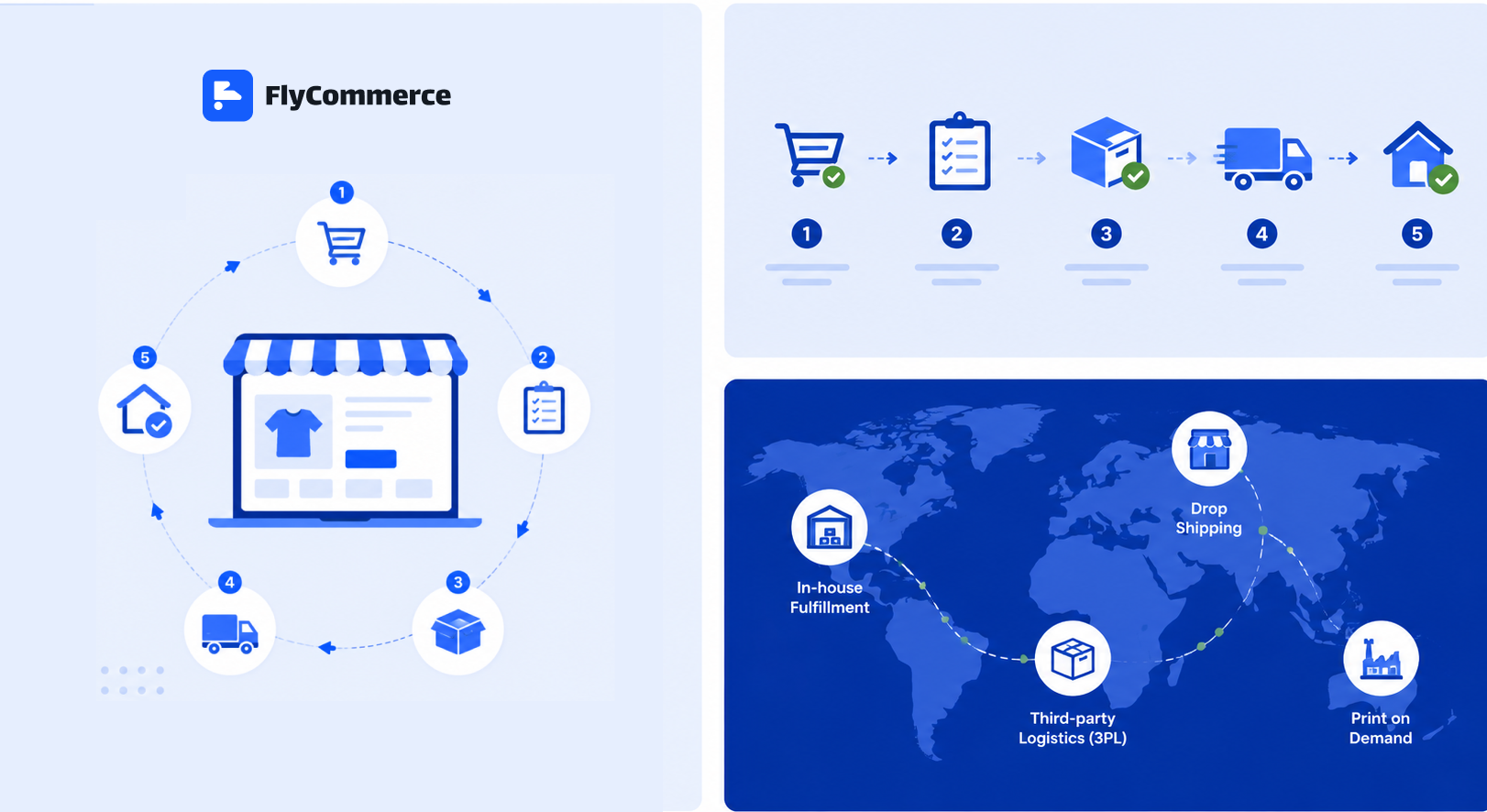
This is the layer that determines your actual margin, your upfront capital needs, and how much operational work the business demands day to day.
8. DTC / Own Inventory
You own the brand, hold your own inventory, and sell it on your own store. This is where the strongest margins and brand equity sit, typically 30% to 50%, but only if you can acquire customers profitably. Building traffic from a standing start is the hardest part of this model.
9. Dropshipping
You list products you never physically hold. When a customer orders, the supplier ships the product directly to the buyer. Startup cost is low because there is no inventory to buy upfront, which is exactly why this model is crowded. Margins typically run 10% to 20%, and you have limited control over product quality or shipping speed since a third-party supplier handles both.
10. Private Label and White Label
You source a generic product from a manufacturer and sell it under your own brand. Private label means the product is made exclusively for you. White label means the same generic product is sold to multiple companies who each rebrand it. Both cost more upfront than dropshipping because you are buying inventory, but both build a defensible brand with margins around 40% or higher.
11. Wholesale
You sell products in bulk to other businesses at a discounted per-unit price. Margins per unit are lower than DTC, typically 15% to 30%, but order sizes are larger and more predictable. Many brands run wholesale alongside their own DTC store, selling to consumers directly while also supplying retailers.
12. Subscription
Customers pay on a recurring basis for regular deliveries or continued access to a service. This creates predictable, recurring revenue that most other models cannot match, which makes the business easier to plan around and often more valuable if you ever sell it. The tradeoff is churn: every renewal has to be earned again, every single cycle.
13. Digital Products
You sell something that exists only in digital form: software, courses, templates, music, or stock media. There is no shipping, no physical inventory, and the cost of serving one more customer is close to zero. The two real challenges are standing out in a crowded digital market and preventing piracy or unauthorized redistribution.
14. Online Marketplace
You build a platform where multiple independent sellers list and sell their own products, and you earn a commission on every transaction that happens through your platform. You never touch the product. You never manage anyone else’s inventory. Your job is building and running the platform: approving vendors, setting commission rates, managing the buyer experience, and keeping the transaction layer working.
This model scales differently than any other on this list because your catalog grows every time you add a seller, not every time you add a product yourself. The tradeoff is the cold start problem: a marketplace with no sellers has nothing for buyers to buy, and a marketplace with no buyers cannot attract sellers. Solving that sequencing problem before launch is the single hardest part of running a marketplace.
For the full breakdown of how marketplace commission, subscription, and listing fee revenue models actually work, read: How Do Online Marketplaces Make Money?
Which Ecommerce Business Model Is Most Profitable?
If you’re asking which model makes the most money, the honest answer is private label and DTC, because you own the brand and are not splitting revenue with a supplier or a platform. But profitability is margin multiplied by your ability to actually sell the product, so the model with the highest margin on paper is not automatically the right choice.
| Model | Startup cost | Typical margin | Best for |
|---|---|---|---|
| Dropshipping | Low | 10% to 20% | Testing demand fast with minimal capital |
| DTC | Medium | 30% to 50% | Founders who can market and want full control |
| Private label | Medium to high | 40%+ | Building a defensible brand over time |
| Wholesale | High | 15% to 30% | Moving volume with predictable, larger orders |
| Subscription | Medium | Recurring, high lifetime value | Products people reorder naturally |
| Marketplace | High | Commission-based | Founders building a platform, not a product line |
A 40% margin on a product nobody buys is worth less than a 15% margin on something that sells consistently. Match the model to your capital, your skills, and the amount of operational complexity you are actually prepared to run.
How to Choose the Right Ecommerce Business Model
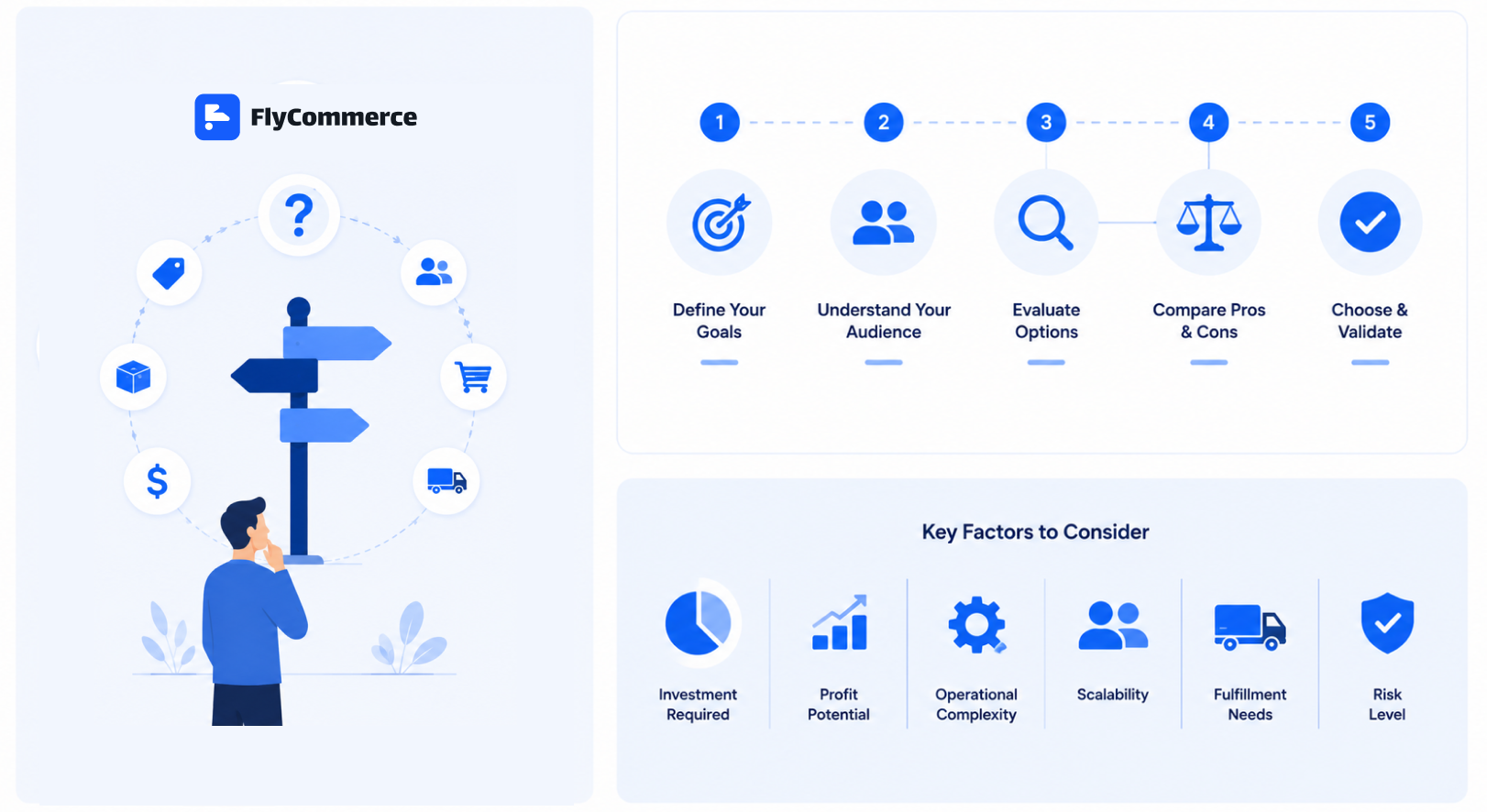
Work through these five questions honestly before committing to a direction.
How much capital can you risk? Wholesale and marketplace models need real upfront capital or a longer runway before revenue arrives. Dropshipping and digital products need almost none.
Do you want to own a brand or just earn a margin? If it’s brand equity you’re after, DTC or private label is the right layer. If margin is the only goal, dropshipping or wholesale get you there faster with less upfront investment.
Can you acquire customers yourself, or do you need a platform’s existing traffic? This is the real decision behind DTC versus marketplace. DTC means you own the customer relationship and drive every visitor yourself. A marketplace model means you’re building the traffic source for other people to sell through.
Is your product a repeat purchase? If people reorder naturally, a subscription layer multiplies lifetime value in a way one-time sales never will.
Who is actually paying, a person or a business? This settles the B2C versus B2B question and reshapes your entire funnel, your sales cycle, and your marketing approach.
| If you… | Choose… |
|---|---|
| Have little capital and want to validate an idea fast | Dropshipping or a small DTC test batch |
| Have a product idea and some working capital | Private label or DTC |
| Already manufacture or make something | DTC, with wholesale added later |
| Want predictable, recurring revenue | Subscription |
| Want to build a platform other sellers operate through | Marketplace |
You don’t have to commit to one combination forever. Many successful businesses run two models at once, most commonly DTC alongside wholesale, or a subscription layered on top of one-time sales.
Whatever combination you land on, the platform you build on should not be the thing holding you back. FlyCommerce is a no-code, cloud-hosted platform that supports both the standalone DTC store model and the multi-vendor marketplace model from one subscription, so switching or combining models later does not mean rebuilding your store from scratch. Shop plans start at $20/month plus a 1% revenue share on yearly billing, and Marketplace plans start at $48/month plus a 1% revenue share. Every plan includes a 14-day free trial.
See FlyCommerce plans and pricing
Frequently Asked Questions About Ecommerce Business Models
What are the main types of ecommerce business models?
The main types split into two layers. By customer relationship: B2C, B2B, D2C, C2C, C2B, B2B2C, and B2G. By fulfillment and revenue: DTC, dropshipping, private label, wholesale, subscription, digital products, and marketplace. Most real businesses combine one model from each layer.
What is the most common ecommerce business model?
B2C is the most common model by transaction volume, since it covers the majority of individual online shopping. By fulfillment model, DTC and dropshipping are the two most common starting points for new sellers because they require the least operational complexity to launch.
What is the difference between B2C and D2C ecommerce?
B2C describes any business selling to individual consumers, including retailers who sell other brands’ products. D2C specifically means a brand selling its own products directly to consumers without a retailer or distributor in between. All D2C is B2C, but not all B2C is D2C.
What is the most profitable ecommerce business model?
Private label and DTC typically carry the highest margins, often 30% to 50%, because the seller owns the brand and is not splitting revenue with a supplier or platform. Profitability also depends on your ability to acquire customers affordably, so the highest-margin model on paper is not always the most profitable in practice.
What is the best ecommerce business model for beginners?
Dropshipping or a small private label test batch are the easiest entry points because they require the least upfront capital. Dropshipping validates demand fastest. Private label costs more upfront but starts building a real, ownable brand from day one.
What is the difference between an ecommerce business model and a revenue model?
A business model is the full structure: who you sell to, how you source or fulfill the product, and your overall growth path. A revenue model is narrower and describes only the pricing mechanic, such as commission, subscription, or one-time sale. Two businesses can share the same revenue model and still be completely different business models.
Can I combine multiple ecommerce business models?
Yes, and most successful ecommerce businesses do. A common combination is running a DTC store while also supplying wholesale to retailers, or adding a subscription option on top of one-time product sales. You don’t need to commit to a single model permanently.
Which ecommerce business model does FlyCommerce support?
FlyCommerce supports both the standalone DTC store model and the multi-vendor marketplace model from one subscription. You can launch a single-vendor store today and add marketplace functionality later without migrating platforms or rebuilding your catalog.