
How Do Online Marketplaces Make Money? 6 Revenue Models Explained

Mamunur Rahsid
21–32 minutes
Human Written
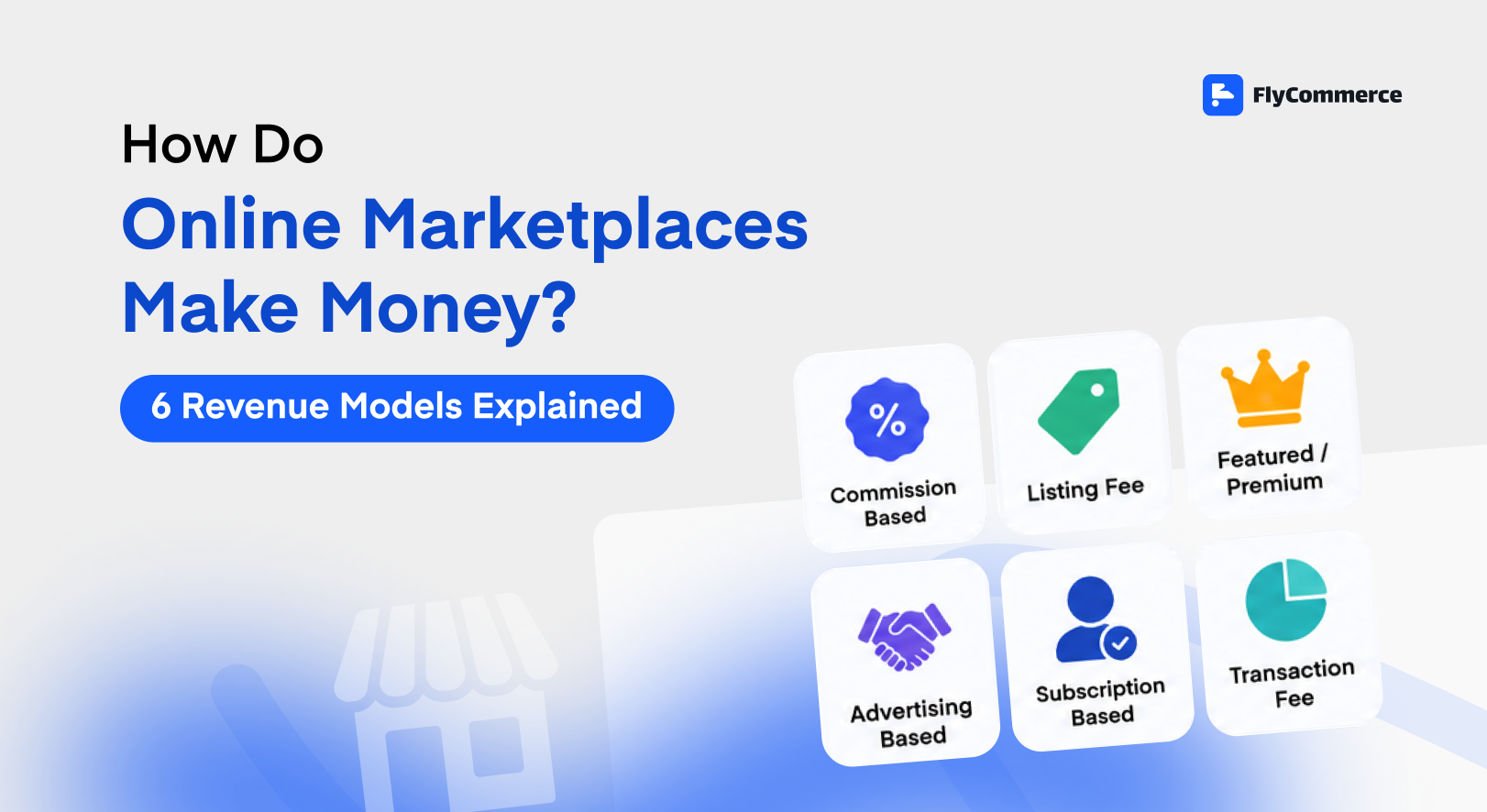
Most marketplace founders think about monetization too late.
They build the platform, recruit vendors, attract buyers, and only then ask how the marketplace should make money. That sequence can create problems later because the revenue model affects commissions, payments, payouts, seller trust, pricing, tax workflows, and platform operations.
Online marketplaces usually make money by connecting buyers and sellers, then charging for transactions, seller access, product listings, visibility, leads, services, or a mix of these models.
In this guide, I will break down the main ways online marketplaces make money, show which revenue model fits which marketplace type, and explain what platform features you need to support each model properly.
TL;DR:
Online marketplaces make money through commissions, vendor subscriptions, listing fees, transaction fees, featured listings, advertising, lead fees, freemium plans, value-added services, and hybrid revenue models.
The best model depends on your marketplace type, transaction value, transaction frequency, seller margins, buyer behavior, and how much value your platform creates for both sides. Here’s a quick breakdown of how online marketplaces make money:
| Revenue model | How it works | Best fit |
| Commission and transaction fees | The marketplace earns from completed sales, bookings, or orders | Product, service, rental, booking, and digital product marketplaces |
| Vendor subscription fees | Sellers pay a recurring fee to access the marketplace or premium seller tools | B2B, niche, professional, or vendor-heavy marketplaces |
| Listing fees | Sellers pay to publish products, services, jobs, properties, or offers | Classifieds, jobs, real estate, cars, and high-value listings |
| Featured listings and advertising | Sellers or brands pay for better visibility inside the marketplace | Marketplaces with steady buyer traffic |
| Lead generation fees | Sellers pay for qualified buyer inquiries | Service, B2B, contractor, and professional marketplaces |
| Value-added services | Sellers pay for extra services such as fulfillment, analytics, verification, or marketing support | Mature marketplaces with operational depth |
Why Your Marketplace Revenue Model Matters
Your revenue model affects more than income. It shapes how sellers join, how buyers pay, how commissions work, how payouts are handled, and how much operational work your team needs to manage.
A commission model needs clean payment and payout workflows. A vendor subscription model needs seller plans and access rules. A listing fee model needs product controls and approval workflows. An advertising model needs traffic, reporting, and trust. A hybrid model needs clear pricing so sellers understand what they are paying for.
The goal is not to charge as much as possible from day one. The goal is to choose a model that helps the marketplace grow while keeping sellers motivated and buyers comfortable.
A good marketplace revenue model should answer four questions:
- Who pays?
- When do they pay?
- What value are they paying for?
- Does the fee align with seller success and buyer trust?
If you haven’t yet decided whether to build a marketplace or a standalone store, read Multi-Vendor vs Single-Vendor Ecommerce: Key Differences and How to Choose first.
What Is a Marketplace Revenue Model?
A marketplace revenue model defines how an online marketplace earns money from buyers, sellers, transactions, visibility, access, or extra services.
It is different from the marketplace business model. The business model explains how the marketplace creates value. The revenue model explains how the marketplace captures part of that value as income.
For example, a marketplace may create value by connecting buyers with trusted vendors. It may capture value by charging a commission on every order, a monthly vendor subscription, a listing fee, or a mix of revenue streams.
6 Ways Online Marketplaces Make Money
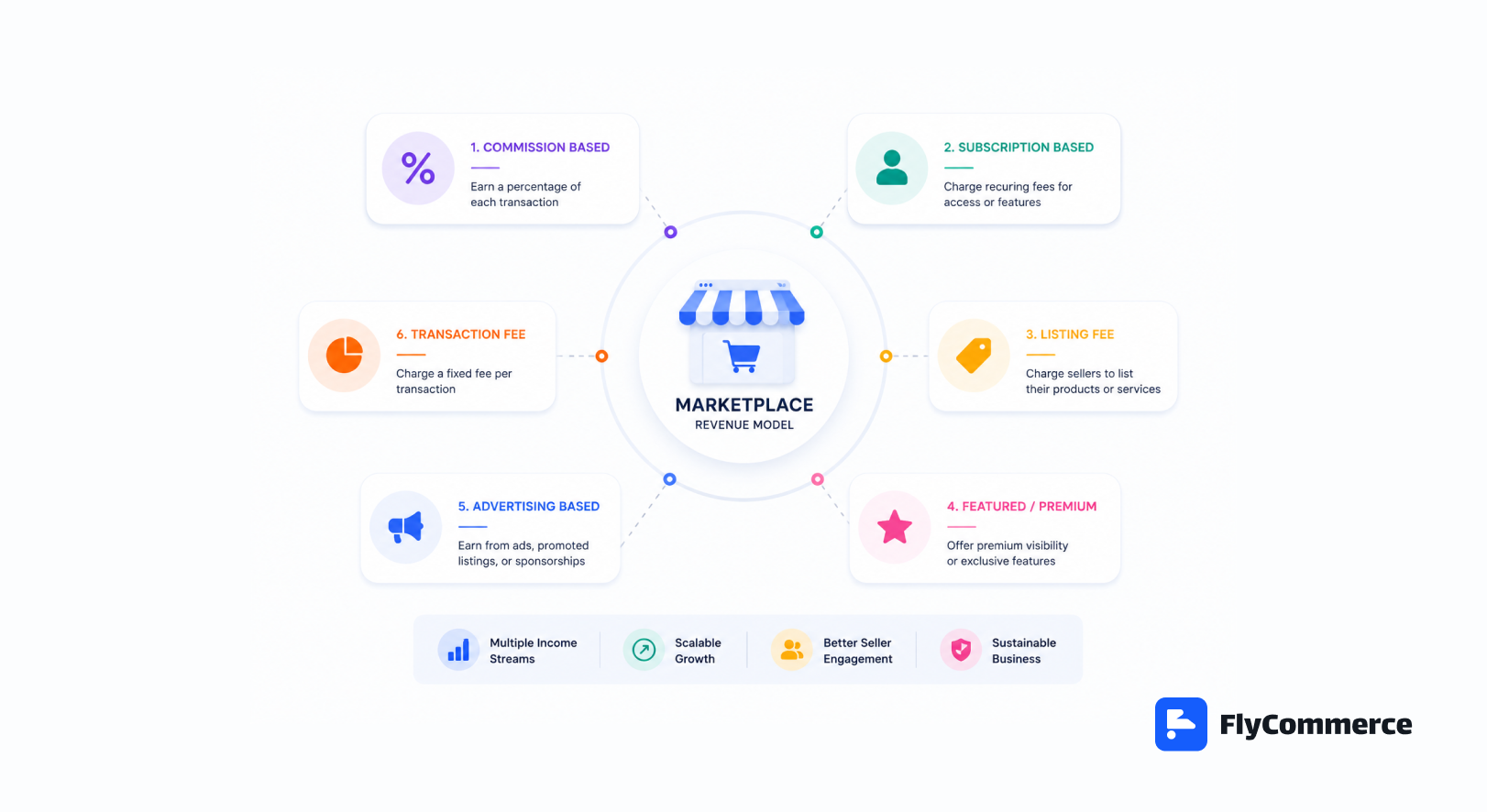
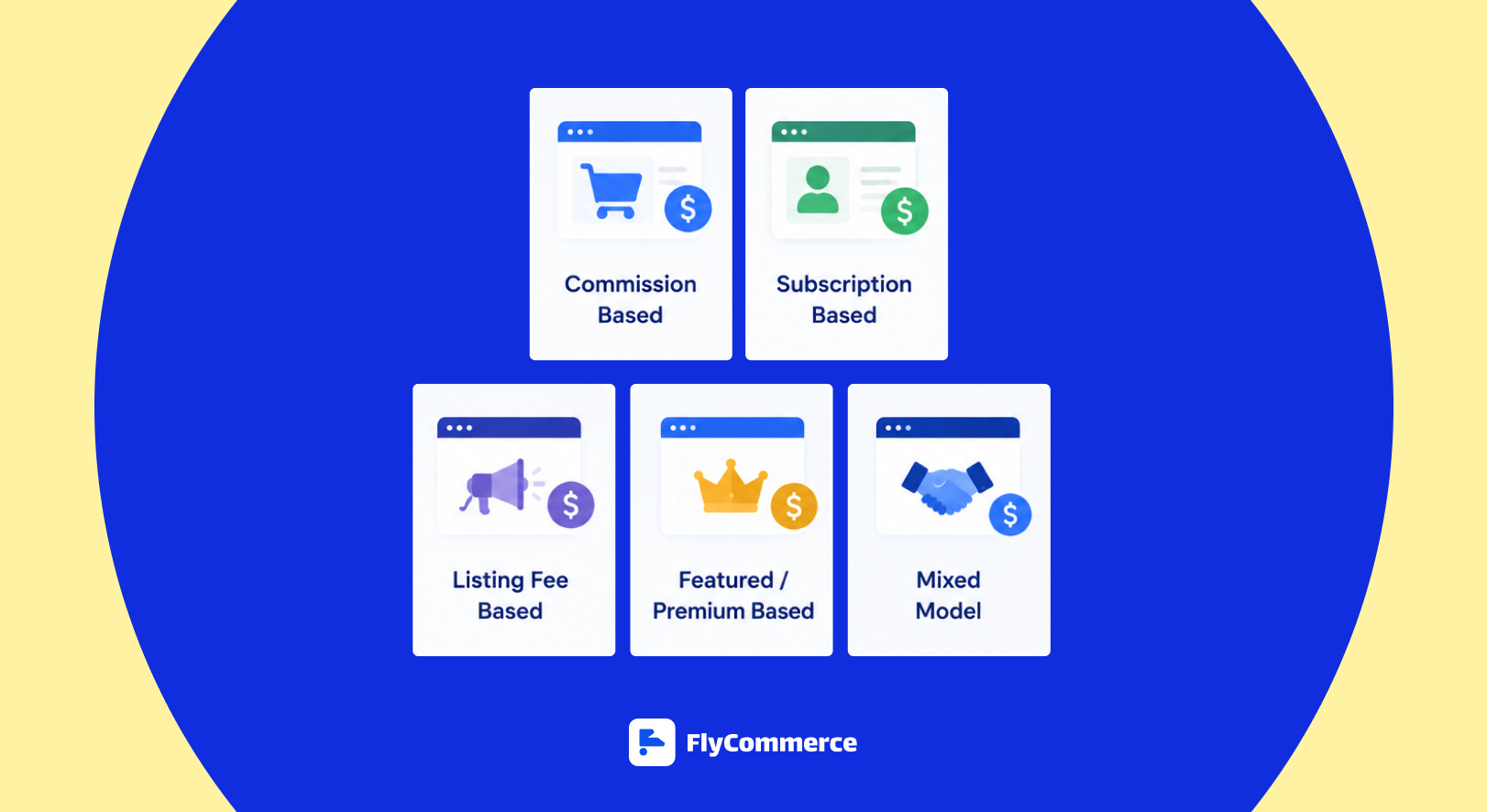
Most online marketplaces use one of the following models at the beginning, then combine multiple models as they grow. Some marketplaces earn when a transaction happens. Some charge sellers for access. Some monetize listings, visibility, leads, or seller services.
The right model depends on what your marketplace sells, who pays, how often transactions happen, seller margins, buyer expectations, and how much value the platform creates for both sides.
Below are six common revenue models marketplace founders should understand before choosing one.
1. Commission and Transaction Fees: The Most Common Model
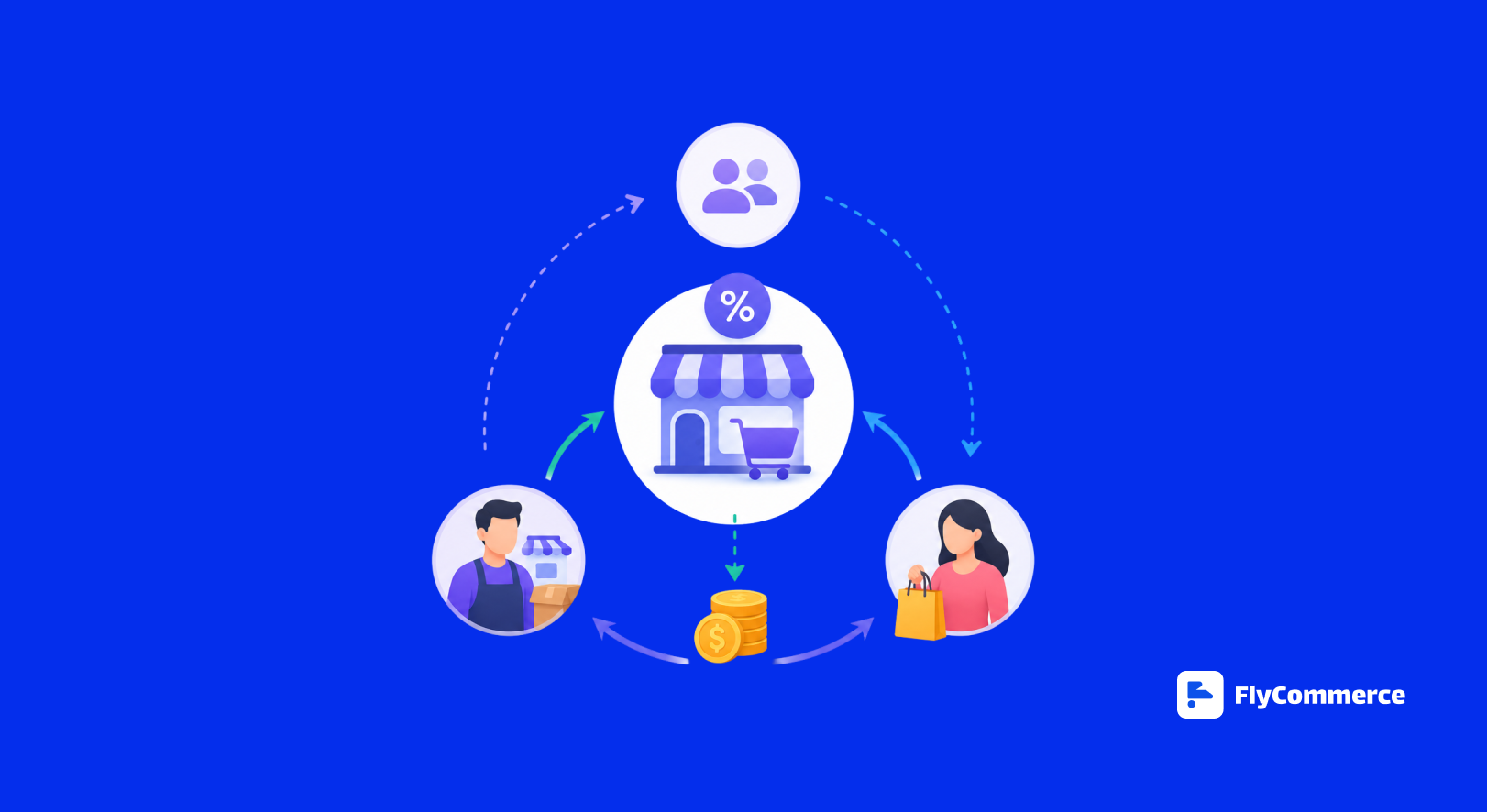
A commission model means the marketplace charges a percentage of each completed sale, booking, or order. In some cases, the marketplace may also charge a fixed fee per transaction.
This is one of the most common marketplace revenue models because it aligns platform revenue with seller success. The seller only pays when a transaction happens. That makes the model easier to accept during the early stage because vendors are not paying before they see results.
Commission is also easy for buyers and sellers to understand. The marketplace helps create demand, process the transaction, support trust, and manage the platform. In return, it earns a share of the completed transaction.
A marketplace analysis of the top 100 marketplaces found that 51% use commission as their primary revenue model. The reason is simple: the marketplace earns when sellers earn.
Commission and transaction fees work well for product marketplaces, service marketplaces, booking marketplaces, rental marketplaces, digital product marketplaces, and marketplaces where checkout happens inside the platform.
Percentage-Based Commission
In a percentage-based commission model, the marketplace takes a percentage of every successful transaction.
For example, if a vendor sells a product for $100 and the marketplace charges a 10% commission, the marketplace earns $10 from that order.
The right commission rate depends on seller margin, transaction value, buyer demand, platform value, payment costs, and competition.
| Marketplace type | Common commission range | Why |
| Product marketplace | 5% to 15% | Product sellers often work with tighter margins |
| Service marketplace | 10% to 30% | The platform may provide matching, trust, workflow, and payment support |
| B2B marketplace | 1% to 5% | Order values are often larger, so lower percentages are easier to accept |
| Rental or booking marketplace | 5% to 20% | Fees may be charged to one side or split between both sides |
These ranges are not fixed rules. A marketplace selling low-margin physical products may need a lower commission. A service marketplace that controls matching, trust, payments, and dispute handling may be able to charge more.
Real Fee Examples From Operating Marketplaces
Here are examples of how different marketplaces structure transaction-related fees.
| Marketplace | Fee example |
| Amazon Marketplace | Referral fees vary by category. Many categories use percentage-based or tiered referral fees. |
| Etsy | Etsy charges a $0.20 listing fee and a 6.5% transaction fee on the order amount. |
| Fiverr | Sellers earn 80% of the purchase amount on completed orders. Fiverr also charges buyers a service fee. |
| Airbnb | In the split-fee model, most hosts pay around 3%, and guests commonly pay 14.1% to 16.5% of the booking subtotal. |
| Reverb | Reverb charges a 5% selling fee on the total sale amount, with a $500 maximum fee in USD. |
These examples show how different marketplaces structure fees. The right fee for your marketplace depends on seller margins, transaction value, buyer demand, and the role your platform plays in the transaction.
Fixed Fee Per Transaction
Instead of charging a percentage, a marketplace can charge a fixed amount per sale, booking, or order.
This works when transactions have a predictable value range. For example, if most orders fall between $20 and $50, a fixed service fee may be easier to understand than a percentage.
Fixed fees can also help cover operational costs like payment handling, customer support, dispute management, booking protection, or payout processing.
Fixed fees can work well when:
- transaction values are predictable
- buyers or sellers prefer simple pricing
- operational costs are similar across orders
- the platform needs to cover fixed processing or support costs
Buyer and Seller Fee Split
Some marketplaces split fees between both sides of the transaction.
For example, a booking marketplace may charge a smaller fee to the provider and another fee to the customer. This can make each individual fee feel smaller, even if the total marketplace revenue is similar.
| Booking value | Provider fee | Customer fee | Marketplace revenue |
| $200 | 3% = $6 | 14% = $28 | $34 |
In this example, the marketplace earns $34 from a $200 booking. That is the same as a 17% total take rate, but the fee is split across both sides.
This approach can work well when both sides receive clear value from the platform. But it needs careful communication. Too many buyer-side fees can reduce conversion.
Commission Math: What It Looks Like at Scale
This is the calculation every marketplace founder should run before setting a commission rate.
| Active sellers | Average monthly sales per seller | Commission rate | Monthly marketplace revenue |
| 10 | $5,000 | 10% | $5,000 |
| 50 | $10,000 | 10% | $50,000 |
| 200 | $10,000 | 10% | $200,000 |
The commission model scales cleanly because the marketplace does not need to own inventory. Revenue grows as sellers generate more sales through the platform.
At the same time, commission only works well when the marketplace keeps sellers active, helps buyers complete transactions, and handles payments, payouts, refunds, reporting, and disputes clearly.
Best Parts
- Easy for vendors to understand
- Marketplace earns when sellers earn
- Revenue grows with transaction volume
- Works well when payments happen inside the platform
- Easier to start with than upfront seller fees
Watch Out For
- High commissions can push sellers off-platform
- Buyer-side fees can reduce conversion
- Refunds and order adjustments need clear handling
- Payment processor fees can reduce margins
- Payout tracking becomes more important as order volume grows
Common Mistake: Setting the Commission Too High Too Early
The biggest commission mistake I see is setting aggressive rates before the marketplace has proven buyer demand.
A high commission can be reasonable when the platform brings sellers steady sales they would not get elsewhere. But if the marketplace has low buyer traffic, sellers may feel the fee is not worth it. Some may raise prices. Others may move buyers off-platform.
A safer approach is to start with a commission rate sellers can accept, then adjust later as the marketplace proves its value.
2. Vendor Subscription Fees: Predictable Revenue From Sellers
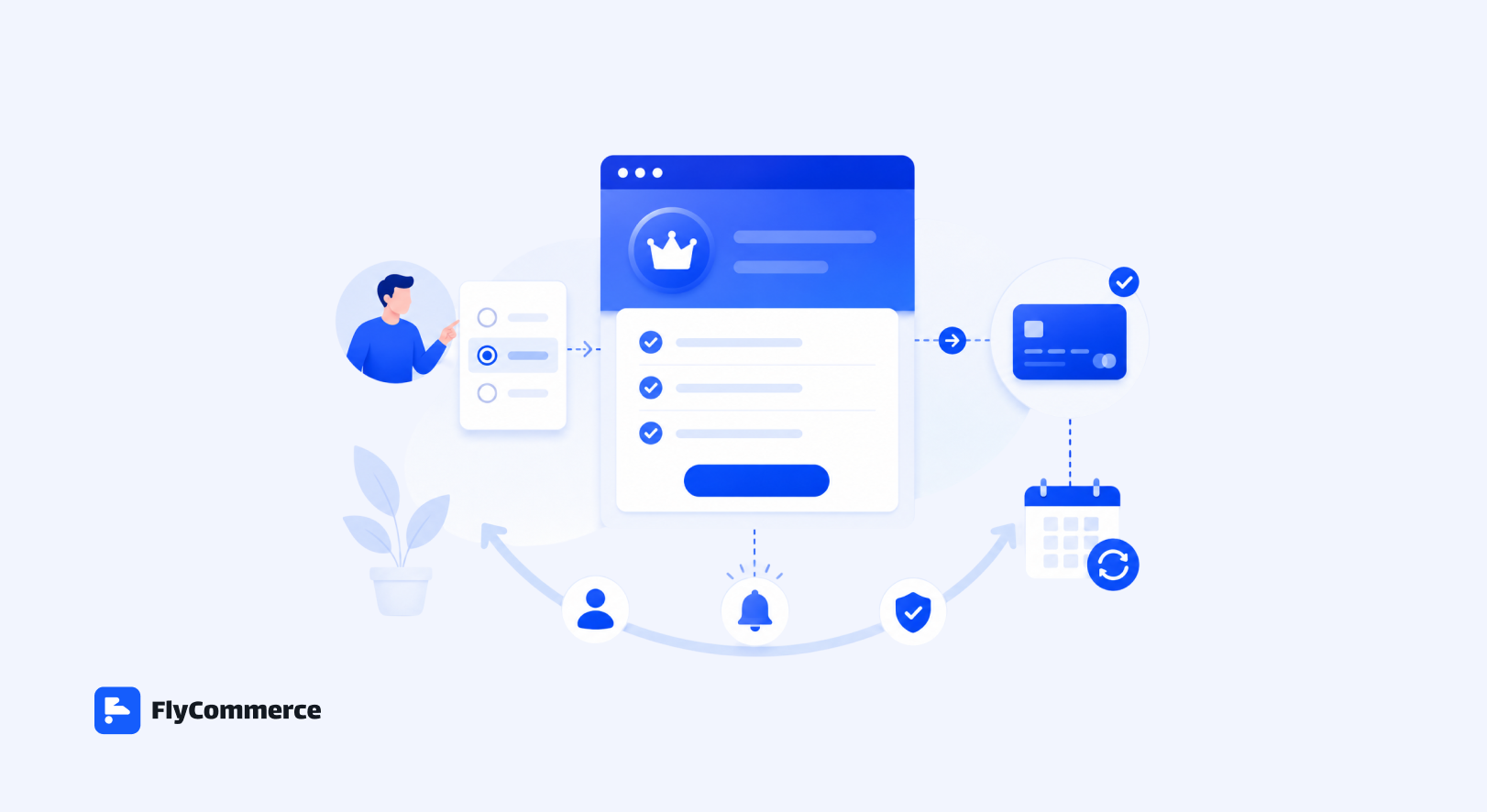
A vendor subscription model means sellers pay a recurring fee to access the marketplace, use premium seller tools, list more products, unlock better selling features, or join a higher seller tier.
This model creates predictable revenue for the marketplace. Instead of depending only on transaction volume, the marketplace can earn monthly or yearly income from vendors.
Vendor subscriptions work best when sellers receive ongoing value from the platform. That value may include access to buyers, vendor dashboards, analytics, product limits, lower commission rates, premium visibility, team access, or advanced seller tools.
For example, a marketplace may offer three vendor plans:
| Vendor plan | Best for | Possible benefit |
| Free | New sellers | Limited product uploads and basic seller access |
| Growth | Active sellers | More product limits, better tools, and reporting |
| Pro | Professional sellers | Advanced features, team access, and priority support |
The exact plan structure depends on the marketplace type. A B2B marketplace may charge vendors for buyer access and lead visibility. A product marketplace may charge vendors for higher product limits or lower commission. A professional marketplace may charge sellers for profile visibility and advanced tools.
Vendor subscriptions are useful for B2B marketplaces, niche marketplaces, wholesale marketplaces, professional seller networks, and marketplaces with repeat vendor activity.
Best Parts
- Creates recurring revenue
- Works well for professional sellers
- Can be packaged into seller tiers
- Does not depend only on transaction volume
- Helps monetize vendor access and seller tools
Watch Out For
- Harder to charge before sellers see value
- Can slow vendor acquisition if introduced too early
- Requires clear plan differences and access rules
- Sellers may compare the subscription fee with actual sales volume
Common Mistake: Charging Sellers Before They See Value
Vendor subscriptions work when sellers believe the marketplace gives them access, tools, data, or demand they cannot easily get elsewhere.
If a marketplace has no buyer activity yet, a subscription fee can feel risky. New sellers usually prefer paying after they make sales. That is why many early marketplaces start with commission, then add optional vendor plans later.
3. Listing Fees: Revenue From Published Listings
A listing fee means sellers pay to publish a product, service, job, property, vehicle, rental, or offer on the marketplace.
This model is common when visibility itself has value. Examples include classified marketplaces, job boards, real estate marketplaces, automobile marketplaces, local service directories, and high-value product categories.
Listing fees can generate revenue before a sale happens. That is attractive for marketplace operators because the platform earns even if the item does not sell.
But listing fees can also reduce supply. If sellers do not yet trust the marketplace, asking them to pay before getting traffic, leads, or sales can slow vendor acquisition.
For a new marketplace, free listings often make more sense until there is enough buyer demand. Once sellers can see traffic, inquiries, or sales potential, listing fees become easier to justify.
Etsy is one example of a marketplace where listing fees are part of the model. Sellers pay a small fee to list an item, then Etsy also earns from transaction fees, payment processing, and advertising services.
Best Parts
- Generates revenue before a sale happens
- Works well for high-intent categories
- Encourages sellers to publish better listings
- Useful when listing visibility has clear value
Watch Out For
- Can discourage new sellers
- May reduce catalog depth
- Needs strong listing approval and quality control
- Works better after the marketplace has buyer demand
Common Mistake: Using Listing Fees Too Early
Listing fees can hurt early marketplace growth if sellers are asked to pay before the marketplace has proven buyer traffic.
A seller with 100 products does not want to pay just to test a platform with no demand. That fee may feel like a toll, not an investment.
Use listing fees when sellers can clearly understand what they get in return: buyer traffic, search visibility, qualified inquiries, or category authority.
4. Featured Listings and Advertising: Revenue From Visibility
Featured listings and advertising let sellers, brands, or third parties pay for better visibility inside the marketplace.
This can include sponsored products, promoted search results, category page placement, homepage sections, marketplace newsletters, brand stores, recommended products, or seasonal collections.
This model works best after the marketplace has steady buyer traffic. Sellers are more willing to pay for visibility when they believe that visibility can lead to sales.
At the early stage, advertising can damage seller trust if there is not enough traffic to justify the cost. A seller who pays for promotion and gets no result may lose confidence in the marketplace.
The key is timing. Advertising should usually come after the marketplace has enough traffic, enough active listings, and enough reporting to show sellers what they received in return.
How Featured Listings Usually Work
| Promotion type | How it works |
| Sponsored search result | Seller pays to appear higher for relevant searches |
| Featured category placement | Seller pays for visibility on a category page |
| Homepage feature | Seller pays for temporary homepage exposure |
| Brand store | Larger sellers or brands pay for a dedicated branded space |
| Newsletter placement | Seller pays to appear in marketplace email campaigns |
| Seasonal collection | Seller pays to be included in curated campaigns |
Featured listings and advertising are powerful because they monetize attention. But they must be managed carefully. If paid listings dominate the experience, buyers may lose trust in marketplace recommendations.
Best Parts
- Creates revenue from visibility
- Useful when sellers compete for buyer attention
- Can support seasonal campaigns and product launches
- Can become a strong revenue stream at scale
Watch Out For
- Not ideal for early-stage marketplaces
- Requires traffic and reporting
- Poor listing quality can hurt trust
- Sponsored placements should be clearly labeled and fairly managed
Common Mistake: Selling Ads Before Traffic Exists
Advertising only works when the marketplace already has buyer attention.
If sellers pay for featured placement but do not receive impressions, clicks, leads, or sales, they may not try again. Before selling ads, make sure the marketplace can report clear performance data.
5. Lead Generation Fees: Revenue From Buyer Inquiries
A lead generation model means sellers pay to receive qualified buyer inquiries.
Instead of charging for a completed sale, the marketplace charges when it connects a seller with a potential customer. This model is common in service marketplaces where the transaction may happen after a consultation, quote, call, or offline discussion.
Lead fees can work well when each lead has high potential value. For example, a contractor, consultant, agency, real estate agent, or B2B service provider may be willing to pay for a qualified lead if one customer can generate meaningful revenue.
This model is useful when the marketplace does not fully control checkout. The platform may still create value by generating demand, collecting buyer requirements, matching buyers with sellers, and passing qualified inquiries to providers.
The challenge is lead quality. Sellers will not keep paying if the marketplace sends low-quality, duplicate, or non-converting leads.
Lead Fee Example
| Scenario | Example |
| Buyer need | A company needs a logistics provider |
| Marketplace role | Collects requirements and matches the buyer with relevant vendors |
| Seller payment | Vendor pays for the qualified lead |
| Marketplace revenue | Revenue comes from the lead, not the final transaction |
This works best when the marketplace can control lead quality and prevent spam.
Best Parts
- Works well for high-value services
- Does not require the full transaction to happen on the platform
- Can monetize buyer demand before checkout exists
- Useful for quote-based or consultation-based marketplaces
Watch Out For
- Sellers may pay even when leads do not convert
- Poor lead quality damages trust quickly
- Off-platform tracking can be difficult
- Lead rules must be clear and fair
Common Mistake: Charging for Weak Leads
Lead fees only work when sellers trust the quality of the inquiry.
A weak lead is worse than no lead because the seller pays money and wastes time. To make this model work, the marketplace needs qualification rules, duplicate lead control, seller matching logic, and clear reporting.
6. Value-Added Services: Revenue Beyond Transactions
Value-added services are paid services that help sellers operate better inside the marketplace.
These can include fulfillment, shipping support, seller verification, premium analytics, marketing help, payment tools, insurance, financing, training, onboarding support, or advanced seller tools.
This model works best when the marketplace has enough operational depth to provide services sellers cannot easily manage alone.
For example, a marketplace may charge sellers for premium analytics, shipping support, product promotion, onboarding help, verified seller status, or advanced reporting. These services create revenue beyond transactions and can also improve seller success.
Value-added services are usually easier to add after the marketplace has active sellers, clear operational needs, and enough data to understand what sellers are willing to pay for.
Common Value-Added Services
| Service type | Why sellers may pay |
| Fulfillment support | Helps sellers store, pack, or ship products more easily |
| Shipping tools | Saves time and simplifies delivery operations |
| Seller verification | Builds trust and can improve conversion |
| Premium analytics | Helps sellers understand demand, pricing, and performance |
| Marketing support | Helps sellers gain visibility and sales |
| Onboarding help | Helps sellers launch faster on the marketplace |
| Payment tools | Helps sellers manage payouts, records, and transaction visibility |
Not every marketplace should offer all of these services. The right services depend on the category, seller maturity, marketplace size, and operational capacity.
Best Parts
- Creates revenue beyond transactions
- Deepens seller dependency on the platform
- Can improve marketplace quality and seller success
- Works well when sellers need operational support
Watch Out For
- Requires operational capacity
- May increase support complexity
- Works better after the core marketplace is active
- Sellers must clearly understand the value of the service
Common Mistake: Offering Services Before Operations Are Ready
Value-added services can create strong revenue, but they also add responsibility.
If the marketplace offers fulfillment, shipping support, verification, or premium support, it must deliver those services reliably. Otherwise, the service becomes a support burden instead of a revenue stream.
Start with services that directly solve seller problems and are simple to manage.
What About Hybrid Marketplace Monetization?
A hybrid revenue model combines two or more revenue streams.
For example, a marketplace may charge commissions, offer vendor subscription plans, sell featured placements, and provide paid seller services.
Hybrid monetization is not a separate seventh model in this article. It is a combination of the six models above.
Many marketplaces eventually move toward a hybrid model because one revenue stream may not capture all the value the platform creates. However, hybrid monetization should be introduced carefully.
Adding too many fees too early can confuse sellers and slow marketplace growth. A better approach is to start with the model that creates the least friction, then add more revenue streams as sellers see value.
| Marketplace stage | Better revenue model | Why |
| Early validation | Commission or free listings | Lower friction helps attract vendors and build supply |
| Growing vendor base | Commission plus optional vendor subscription | Subscriptions can create predictable revenue once vendors see value |
| Steady traffic and transactions | Commission, subscriptions, and featured placements | Sellers may pay more when visibility clearly drives sales |
| Mature marketplace | Hybrid revenue model | Larger marketplaces can combine commissions, subscriptions, ads, services, and seller tools |
The timing matters. Listing fees, ads, and subscriptions are easier to introduce when sellers already believe the marketplace can bring them buyers. Charging too early can slow vendor acquisition.
Marketplace Revenue Model Examples
Here are simple examples of how different marketplaces commonly monetize. Exact fees can change over time, so use these as model examples rather than fixed pricing benchmarks.
| Marketplace type or example | Common revenue model | Why it works |
| Amazon-style product marketplace | Referral fees, seller plans, ads, fulfillment services | Sellers pay for access to buyer demand, logistics, and visibility |
| Etsy-style creative marketplace | Listing fees, transaction fees, payment processing, ads | Creative sellers pay to list products and gain visibility |
| Airbnb-style rental marketplace | Service fees on bookings | The platform earns when hosts and guests complete a booking |
| Fiverr-style service marketplace | Seller commission and buyer-side service fees | The platform earns when service transactions happen |
| Reverb-style niche product marketplace | Selling fee on completed transactions | Sellers pay when an item sells |
| B2B marketplace | Subscription, commission, lead fees, or hybrid | Sellers often pay for access, leads, or transaction volume |
| Local service marketplace | Lead fees, subscriptions, or featured listings | Service providers pay for qualified buyer demand |
Which Revenue Model Fits Which Marketplace Type?
The right revenue model depends on how buyers and sellers use the marketplace. A product marketplace, B2B marketplace, service marketplace, and rental marketplace do not monetize in the same way.
| Marketplace type | Best starting revenue model | Why |
| Product marketplace | Commission or hybrid | Revenue grows with sales and sellers pay when they earn |
| B2B marketplace | Subscription, commission, lead fee, or hybrid | B2B sellers may pay for access, leads, or transaction volume |
| Service marketplace | Commission or lead fees | The platform creates value by matching buyers with providers |
| Rental or booking marketplace | Commission or service fees | The platform earns when bookings happen |
| Digital product marketplace | Commission, subscription, or listing fees | Digital catalogs scale well and can support multiple monetization paths |
| Local marketplace | Listing fees, subscriptions, or ads | Local sellers may pay for visibility once traffic exists |
| Enterprise marketplace | Hybrid model | Complex operations usually need multiple revenue streams |
How to Choose the Right Marketplace Revenue Model
Choosing a marketplace revenue model is not only a pricing decision. It is an operating decision. Before choosing, review these factors.
**Transaction value:**High-value transactions can support lower percentage fees. Low-value transactions may need subscriptions, ads, or fixed fees to stay profitable.
**Transaction frequency:**If transactions happen often, commission can work well. If transactions are rare, listing fees, lead fees, or subscriptions may make more sense.
**Seller profit margin:**If sellers have thin margins, a high commission can push them away. If the platform delivers strong buyer demand, sellers may accept higher fees.
**Buyer price sensitivity:**Buyer-side fees can hurt conversion if buyers feel surprised at checkout. Make fees clear before payment.
**Seller maturity:**Professional sellers may accept subscriptions if the platform provides tools, analytics, or reliable demand. New sellers usually prefer paying only after sales happen.
**Marketplace liquidity:**If you do not yet have enough buyers and sellers, keep monetization simple. Heavy fees can slow early adoption.
**Off-platform risk:**If buyers and sellers can easily bypass your platform, you need to provide enough value to keep transactions inside the marketplace.
**Payment and payout complexity:**Commission, transaction fees, refunds, and vendor payouts need clean payment infrastructure.
**Tax and compliance needs:**Marketplaces that handle payments across regions may need tax calculation, reporting workflows, exemption handling, and clear records.
**Platform feature support:**Your platform must support the model you choose. Strategy alone is not enough if the software cannot manage the workflow.
When Should You Add Each Revenue Model?
The timing matters. Some revenue models work better after the marketplace has vendors, traffic, and trust.
| Marketplace stage | Better revenue model | Why |
| Early validation | Commission or free listings | Lower friction helps attract vendors and build supply |
| Growing vendor base | Commission plus optional vendor subscription | Subscriptions can create predictable revenue once vendors see value |
| Steady traffic and transactions | Commission, subscriptions, and featured placements | Sellers may pay more when visibility clearly drives sales |
| Mature marketplace | Hybrid revenue model | Larger marketplaces often combine commissions, subscriptions, ads, services, and seller tools |
Listing fees, ads, and subscriptions are easier to introduce when sellers already believe the marketplace can bring them buyers. Charging too early can slow vendor acquisition.
What Marketplace Features Do You Need to Monetize Properly?
A revenue model only works if the marketplace platform can support it operationally. Before choosing a model, make sure your platform has the right tools.
| Revenue model | Required platform features |
| Commission | Flexible commission rules, payment workflows, refund handling, payout tracking, reporting |
| Vendor subscription | Vendor plans, seller access rules, product limits, billing controls, vendor dashboard |
| Listing fee | Product listing controls, approval workflow, listing limits, vendor product management |
| Transaction fee | Payment workflows, fee calculation, buyer and seller records, reporting |
| Featured listings or ads | Promotion tools, placement controls, analytics, seller reporting |
| Lead fee | Lead capture, seller assignment, lead quality controls, conversion tracking |
| Value-added services | Integrations, reporting, vendor tools, fulfillment or service workflows |
| Hybrid model | Flexible monetization settings, clear reporting, vendor billing visibility |
At a minimum, check whether your marketplace platform supports:
- Vendor onboarding and approval
- Vendor dashboard
- Commission rules
- Vendor subscription plans
- Category-based commission
- Seller verification
- Manual and automatic payouts
- Custom payout schedules
- Refund handling
- Marketplace reporting
- Tax calculation and reporting workflows
- Product SEO and marketplace SEO
- Payment gateway support
- Shipping controls
- Analytics and performance visibility
Common Mistakes When Monetizing an Online Marketplace
Most marketplace monetization mistakes happen because founders copy another marketplace without checking their own audience, margins, category, and platform capabilities.
Charging too early: If sellers do not yet see buyer demand, subscription or listing fees can feel like a risk instead of an investment.
Charging too much: High fees can push sellers toward other platforms or direct selling channels.
Copying another marketplace blindly: Amazon, Airbnb, Etsy, and Fiverr have different models because their transactions, buyer behavior, and seller economics are different.
Ignoring seller margins: A commission that works for handmade goods may not work for wholesale products or B2B orders.
Ignoring payment processor fees: Payment costs can reduce your real margin if they are not included in your pricing model.
Monetizing before solving supply and demand: If the marketplace does not yet create enough value, monetization will expose the weakness faster.
Ignoring off-platform deals: If users can easily bypass the marketplace, fees must be balanced with trust, convenience, protection, and workflow value.
Not explaining fees clearly: Sellers should understand what they pay, when they pay, and what they receive in return.
Forgetting tax, payouts, and refunds: Revenue models affect finance operations. Refunds, adjustments, vendor payouts, and tax records must be planned early.
Choosing a platform that cannot support the model: A monetization strategy is only useful if your marketplace software can actually run it.
Marketplace Revenue Model Checklist
Use this checklist before choosing how your marketplace will make money.
- Do sellers earn enough margin to pay a commission?
- Does the marketplace create value before or after a transaction?
- Will sellers pay before receiving buyer demand?
- Is the transaction value high or low?
- Are transactions frequent or rare?
- Will buyers accept service fees?
- Can sellers bypass the platform easily?
- Does the model support early vendor acquisition?
- Can the platform handle commissions and payouts?
- Can the platform support vendor subscription plans?
- Can the platform manage listing controls if needed?
- Can the platform support refunds and adjustments?
- Can you report revenue by vendor, product, or category?
- Do you need tax calculation and reporting workflows?
- Can the model scale without becoming confusing?
- Will the model still make sense two years from now?
How FlyCommerce Helps Marketplace Founders Monetize
A marketplace revenue model only works if the platform can support it operationally.
FlyCommerce helps marketplace founders and marketplace operators manage key monetization workflows from one cloud ecommerce platform. It supports vendor onboarding, vendor dashboards, vendor subscription plans, flexible commission structures, category-based commission management, seller verification, vendor team management, manual and automatic payouts, custom payout schedules, reporting, marketplace SEO, product SEO, shipping rules, and payment workflows.
FlyCommerce also includes an Avalara AvaTax certified integration for US tax calculation and reporting workflows, along with B2B exemption certificate handling through Avalara ECM. This does not mean FlyCommerce files or remits taxes for you. Tax filing and remittance require separate services and should be reviewed based on your business requirements.
This makes FlyCommerce useful for founders who want to build a marketplace without managing hosting, plugins, server setup, or separate systems for vendor operations.
Related guide: Best Multi-Vendor Marketplace Platforms in 2026.
FAQs About How Online Marketplaces Make Money
How do online marketplaces make money?
Online marketplaces make money through commissions, vendor subscriptions, listing fees, transaction fees, featured listings, advertising, lead fees, freemium plans, value-added services, and hybrid revenue models. Most marketplaces start with one simple model and add more revenue streams as they grow.
What is the most common marketplace revenue model?
Commission is one of the most common marketplace revenue models. The marketplace earns a percentage of each completed transaction, so platform revenue grows when sellers earn more.
Do online marketplaces make money from buyers or sellers?
Most marketplaces charge sellers because sellers are paying for access to buyer demand. Some marketplaces charge buyers, and some split fees between both sides. The best choice depends on the marketplace type and buyer expectations.
What percentage should a marketplace charge as commission?
There is no universal commission rate. Product marketplaces often use lower to mid-range percentages, service marketplaces may charge higher percentages, and B2B marketplaces often need lower rates because order values are larger. The right rate depends on seller margins, transaction value, and how much demand the marketplace creates.