
Multi-Vendor vs Single-Vendor Ecommerce: Key Differences and How to Choose

Mamunur Rahsid
11–17 minutes
Human Written
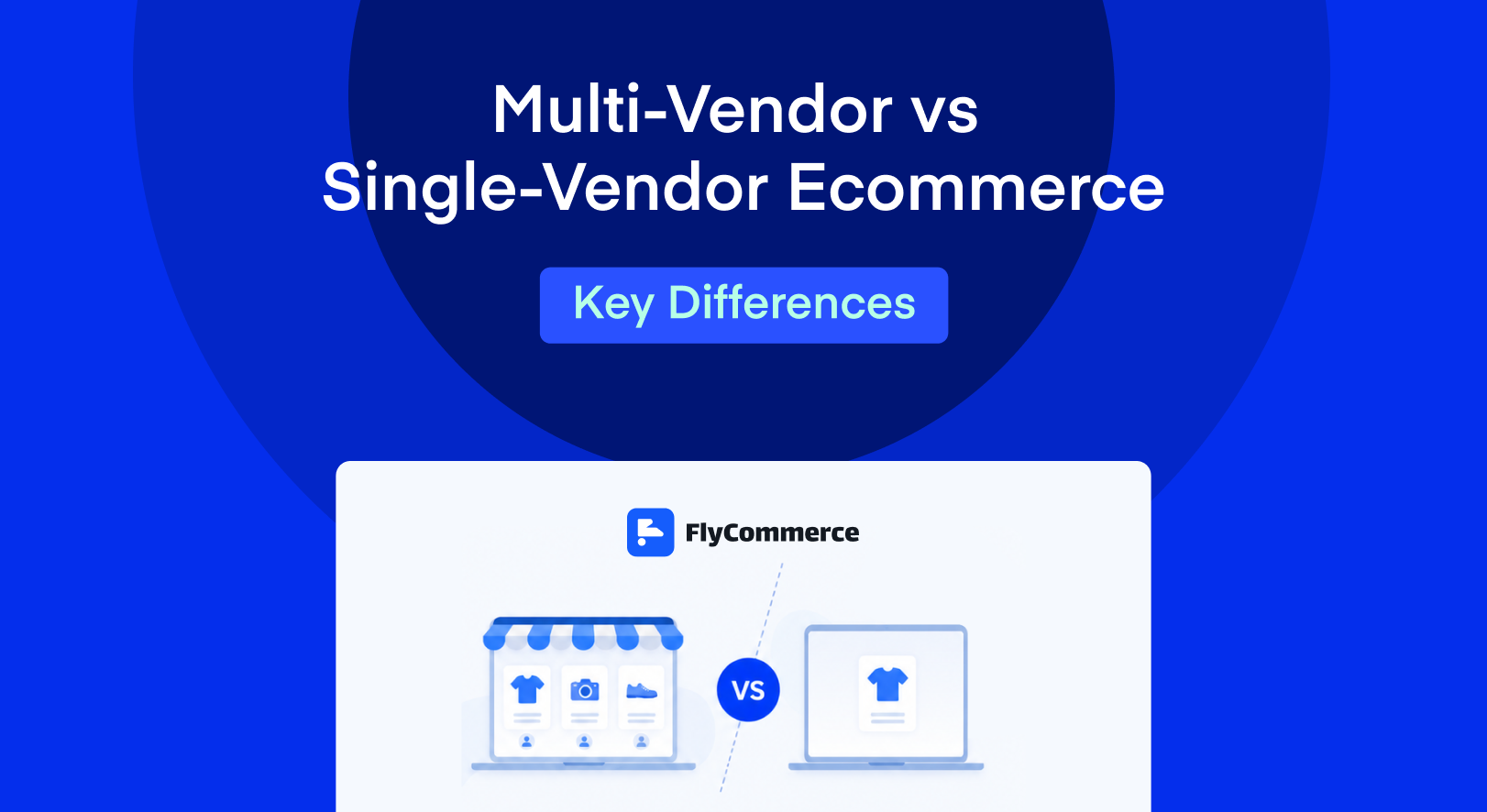
Multi-Vendor marketplace and Single-Vendor ecommerce are not two versions of the same thing. They are fundamentally different business models with different revenue structures, different scaling economics, and different platform requirements. Picking the wrong one means rebuilding from scratch mid-growth.
I’ve spent years working alongside the team behind Dokan, the WordPress plugin powering 40,000+ active marketplaces worldwide. I’ve watched founders choose the wrong model more times than I can count. This is the breakdown that prevents that.
This guide explains both models clearly, compares them across every factor that affects your business, and gives you a concrete decision framework so you can choose the right model before you build a single page.
TL;DR:
Single-vendor ecommerce has one seller managing their own products, inventory, and margins. Multi-vendor marketplace has many sellers on one platform while the platform owner earns commission without touching inventory. Multi-vendor scales faster but is more complex to build. Single-vendor is simpler to launch but limited by your own capital and stock. FlyCommerce supports both from one platform.
At a glance
| Factor | Single-Vendor Ecommerce | Multi-Vendor Marketplace |
| Sellers | You only | Many independent sellers |
| Revenue | Product margins | Commission and subscription fees |
| Inventory | You manage it | Sellers manage their own |
| Complexity | Lower | Higher |
| Growth ceiling | Limited by your stock | Unlimited via network effects |
The Difference That Determines How Your Business Scales
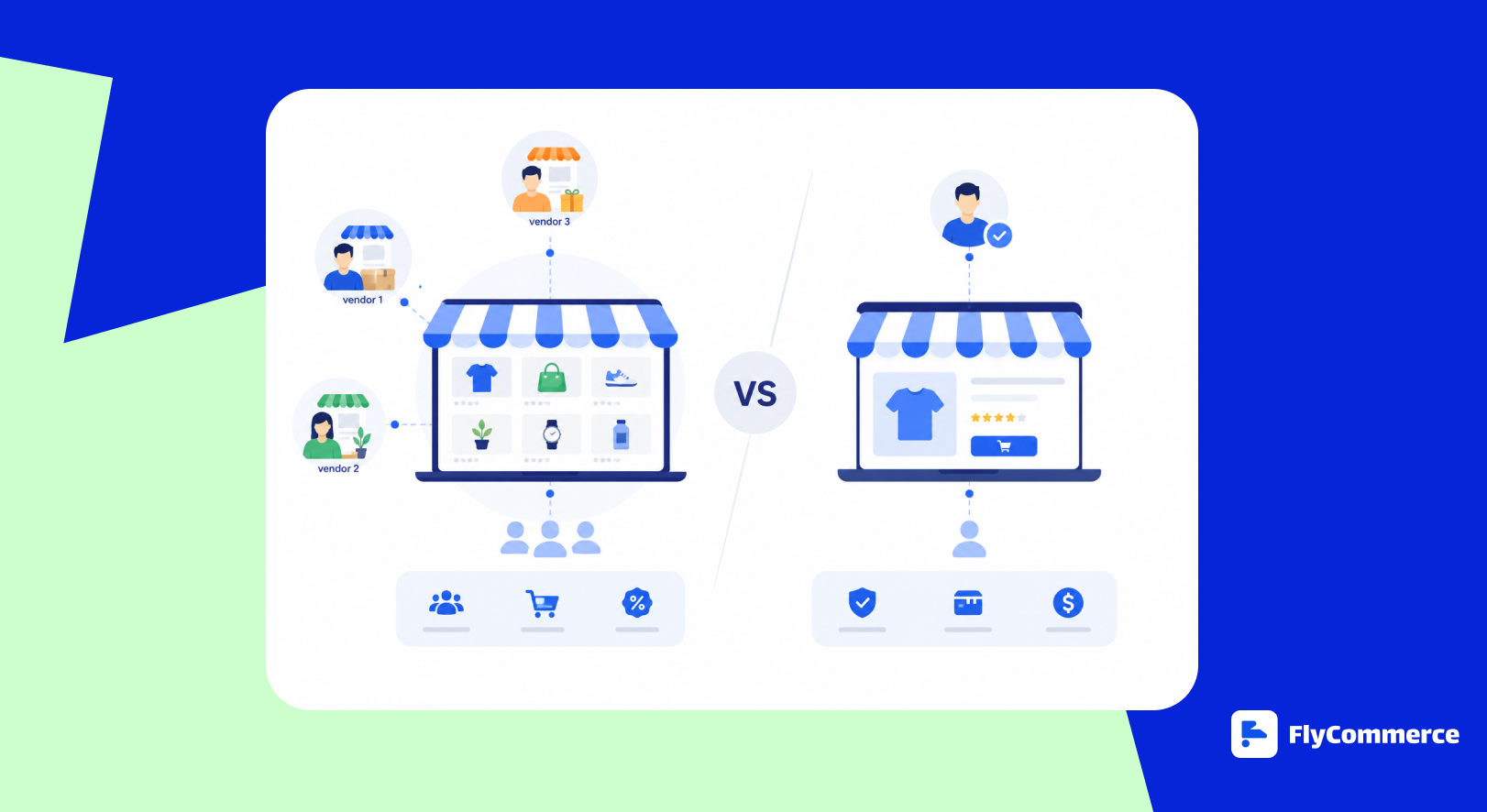
The difference between single-vendor and multi-vendor ecommerce is a fundamental difference in business model. In single-vendor ecommerce, your revenue comes from selling your own products. Your growth ceiling is your own inventory, capital, and fulfillment capacity. In multi-vendor marketplace, your revenue comes from commission on other people’s sales. Your growth ceiling is the size of the seller and buyer network you build.
Those are different businesses. They have different risks, different revenue profiles, different platform requirements, and different scaling economics.
Get this decision wrong and you will spend twice the time and money rebuilding later. Many businesses still launch with a model that limits them from day one, build a single-vendor store, hit a growth ceiling, and then spend twice the time and money converting to a marketplace later.
Here is how to get it right from the start.
What Is Single-Vendor Ecommerce?
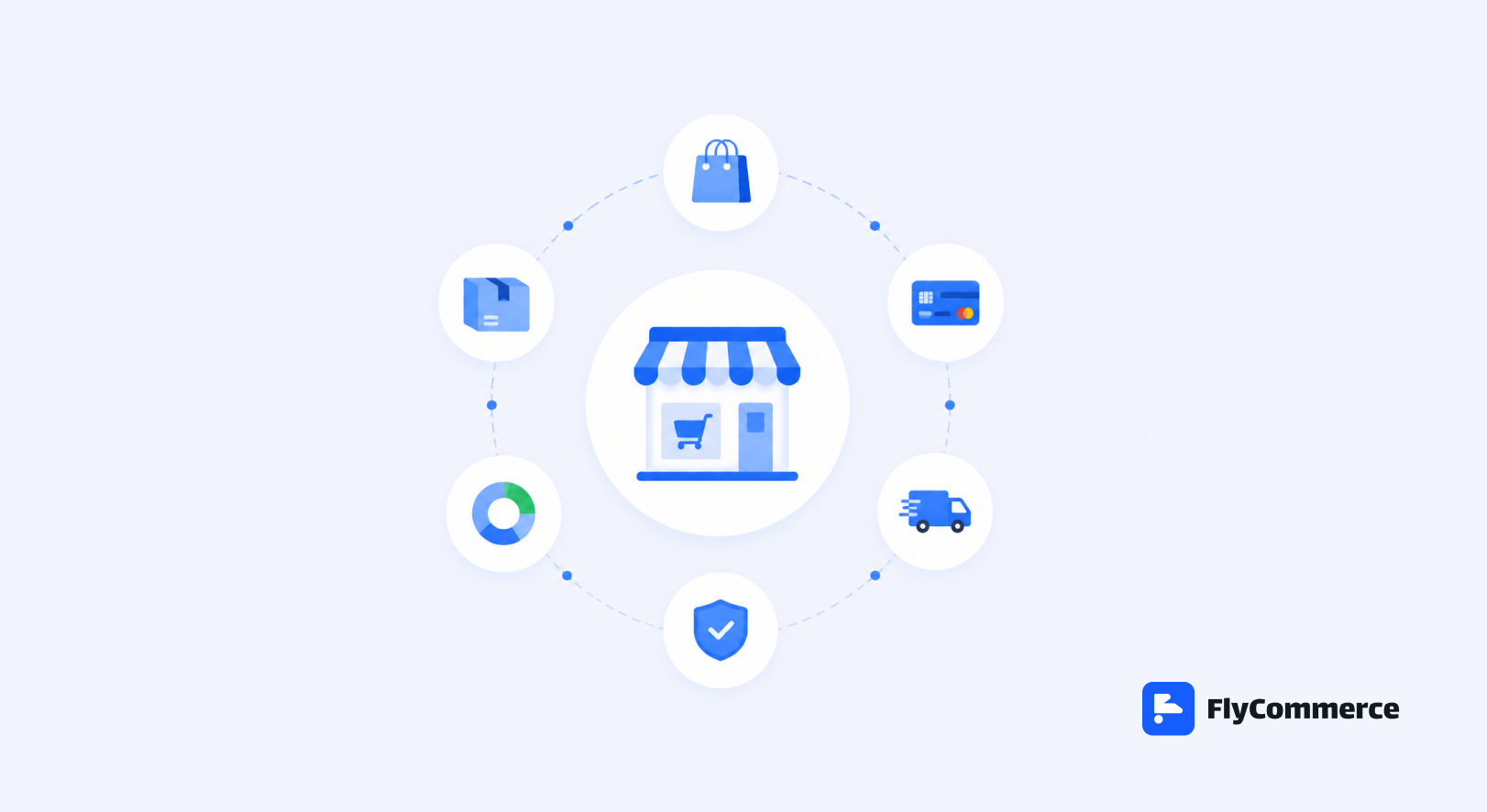
Single-vendor ecommerce is an online store where one business sells its own products or services directly to customers, managing its own inventory, pricing, fulfillment, and customer relationships.
The store owner controls everything. What products appear, how they are priced, how they are shipped, and what the entire customer experience looks like. Revenue comes from the margin between what each product costs and what a customer pays.
Nike.com is a single-vendor ecommerce store. So is Apple’s online store, Glossier, and every Shopify merchant selling their own products. One brand, one seller, one catalog.
Key Characteristics of Single-Vendor Ecommerce
- One seller manages all products, inventory, and pricing
- Revenue model: product margins on every direct sale
- Full brand control over design, messaging, and customer experience
- Direct customer relationships with first-party data ownership
- Growth limited by your own inventory, capital, and logistics capacity
- Lower operational complexity: one checkout flow, one fulfillment process
- Faster to launch: no vendor onboarding, no commission management, no payment splitting
I’ve seen this model work best for established brands, DTC businesses, and anyone selling a curated, proprietary product line. The limitation becomes clear when growth requires more capital: adding new products means buying more inventory. Expanding to new markets means building more logistics. Every unit of growth requires direct investment
Single-Vendor Ecommerce: Pros and Cons
Every model has genuine advantages and real constraints. Here is the honest breakdown of both
| Pros | Cons |
| Faster to launch. No vendor onboarding, no payment splitting, no commission rules.Complete brand control. Every detail of the customer experience is yours.Full customer data ownership. Every buyer is your buyer. You own the relationship.Simpler operations. One seller, one checkout flow, one fulfillment process.Lower complexity to start. Shopify or FlyCommerce Shop plan and you are live in under 60 minutes. | Linear growth ceiling. Every unit of growth requires capital investment in inventory.Inventory risk. You own unsold stock. Overbuying is expensive. Underbuying means missed sales.No network effects. Adding buyers does not automatically attract more buyers.Operational scaling is expensive. More products means more warehouse space, staff, and logistics cost. |
What Is Multi-Vendor Marketplace?
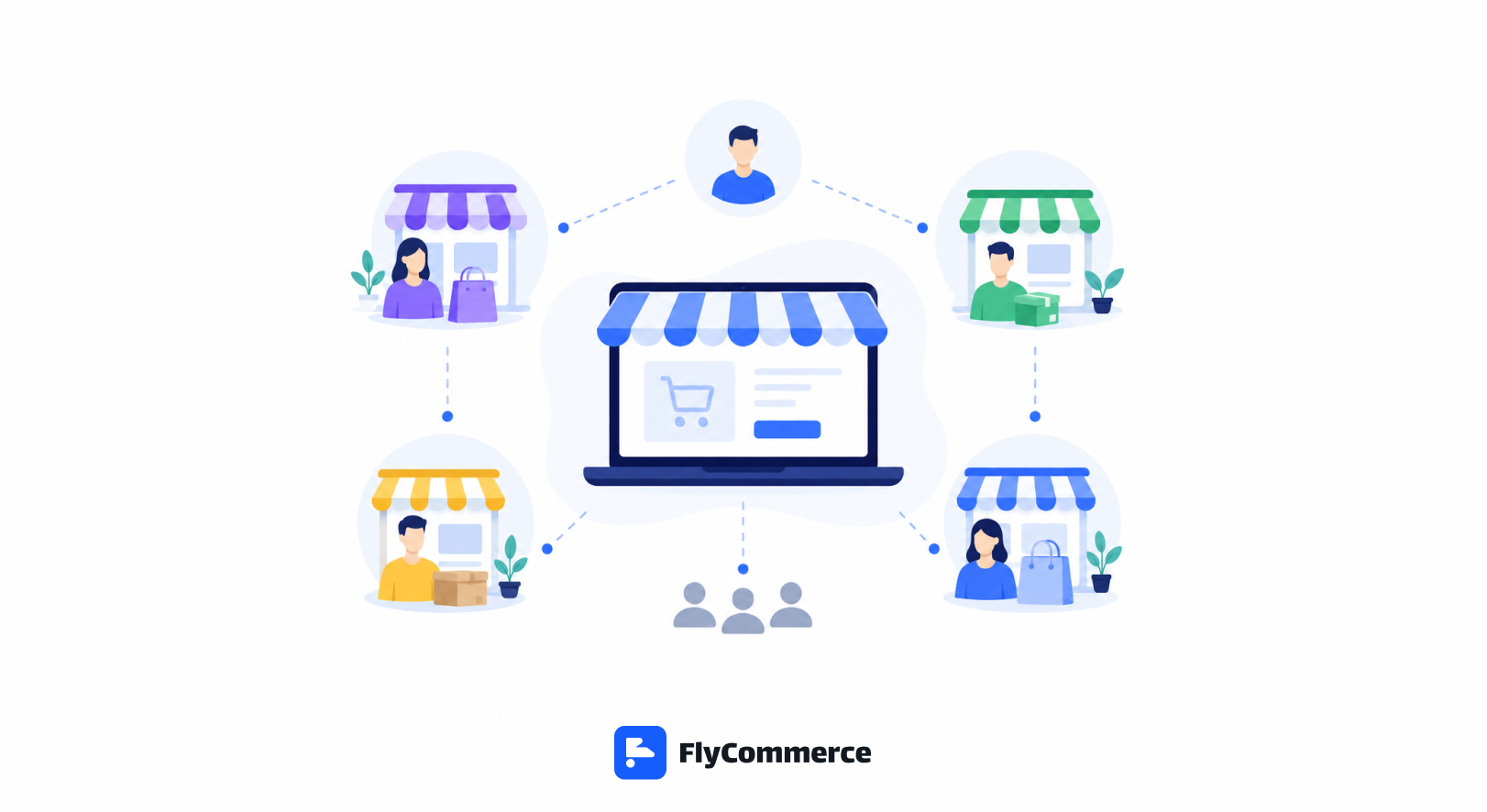
Multi-vendor ecommerce is a platform where multiple independent sellers list and sell their products or services, while the platform owner earns revenue through commissions, subscription fees, or both, without managing inventory or fulfilling orders directly.
The platform owner builds the infrastructure and sets the rules. The sellers bring their own products, manage their own inventory, and handle their own fulfillment. The platform earns a percentage of every transaction that happens on it.
Amazon is a multi-vendor ecommerce platform. So is Etsy, Airbnb, Fiverr, and every marketplace where multiple independent sellers operate. One platform, many sellers, one set of rules.
Key Characteristics of Multi-Vendor Ecommerce
- Multiple independent sellers, each managing their own products and inventory
- Revenue model: commission on every sale (typically 5 to 30%) plus optional seller subscription fees
- Platform owner earns without holding stock or fulfilling a single order
- Network effects: value compounds as more sellers and buyers join
- Growth ceiling unlimited: every new seller adds supply without adding cost to the platform owner
- Higher operational complexity: vendor onboarding, payment splitting, commission management, tax compliance
- Longer time to first sale: requires seller supply before buyers convert
Multi-Vendor Ecommerce: Pros and Cons
Every model has genuine advantages and real constraints. Here is the honest breakdown of both
| Pros | Cons |
| Exponential growth potential. Every new seller adds supply without adding cost to you.Zero inventory risk. Sellers own their stock. You never buy or store anything.Multiple revenue streams. Commission, subscriptions, listing fees, and advertising can all coexist.Network effects compound. More sellers attract more buyers, which attract more sellers.Platform economics improve with scale. Your cost per transaction decreases as volume grows. | Higher build complexity. Vendor onboarding, payment splitting, commission management, and tax compliance all require platform investment.Cold start problem. You need sellers before buyers convert, and buyers before sellers commit fully. The chicken-and-egg problem is real.Less brand control. Individual sellers have their own branding. Consistency is harder to maintain.Tax complexity. Multi-seller transactions require sophisticated tax calculation across multiple jurisdictions. |
| Explore the detailed comparison between Marketplace and Online Store to find the right fit for your business. |
Multi-Vendor vs Single-Vendor Ecommerce: Core Differences
Here is the comparison across every factor that determines which model fits your goals.
| Factor | Single-Vendor Ecommerce | Multi-Vendor Ecommerce |
| Business structure | Direct relationship between one seller and buyers | Three-way relationship: platform owner, sellers, and buyers |
| Who sells | One business , the store owner | Multiple independent sellers on one platform |
| Inventory ownership | Store owner sources, stores, and manages all stock | Each seller manages their own inventory independently |
| Revenue model | Product margins on every direct sale | Commission 5 to 30% per sale plus optional seller subscriptions |
| Scalability | Linear , growth requires more inventory and capital investment | Exponential , every new seller adds supply without adding cost to the platform |
| Operational complexity | Lower , one seller, one checkout, one fulfillment process | Higher , vendor onboarding, payment splitting, commission rules, tax compliance |
| Network effects | None , adding one buyer does not attract another | Yes , more sellers attract more buyers, which attract more sellers |
| Brand control | Complete , full control over design, messaging, and experience | Partial , platform sets rules, sellers have their own brand presence |
| Customer data ownership | Full first-party data on every buyer | Platform owns the data; individual sellers have limited access |
| Time to first sale | Fast , set up products, configure payment, start selling | Slower , requires seller recruitment and onboarding before buyers convert |
| Risk profile | Inventory risk: you own unsold stock | Liquidity risk: you need both sellers and buyers simultaneously |
| Examples | Nike.com, Apple Store, Glossier, any Shopify DTC brand | Amazon, Etsy, Airbnb, Fiverr, eBay |
Pro tip: Choosing your platform before choosing your model. I’ve seen founders build a single-vendor Shopify store, then try to add marketplace functionality with third-party apps. The apps don’t split payments cleanly. Commission reconciliation becomes a weekly spreadsheet nightmare. Vendor dashboards are half-built. A year later they’re rebuilding from scratch, on a platform designed for marketplaces from day one. The model decision comes first. Always.
Revenue Model Comparison: Where the Real Difference Lives
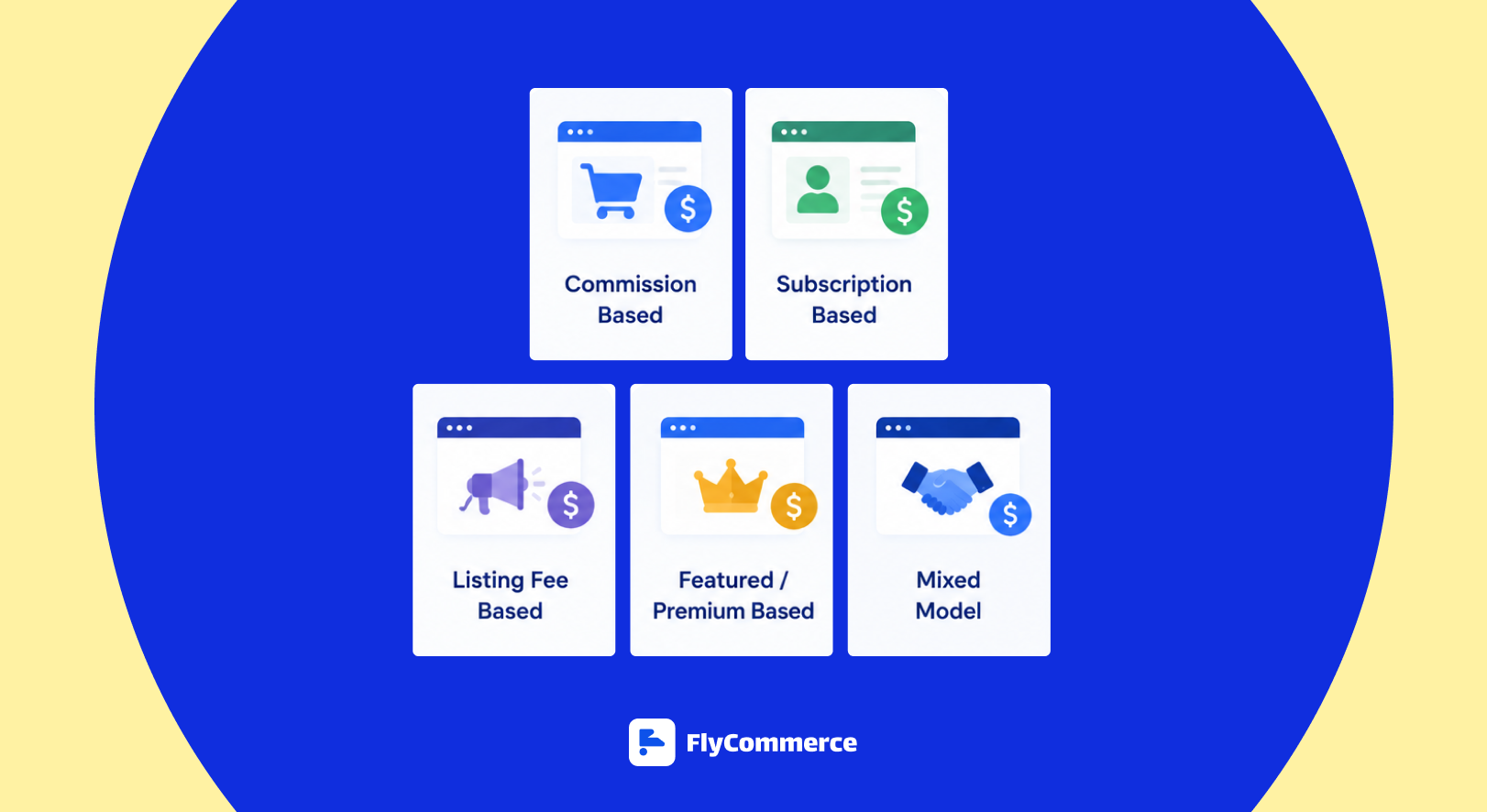
This is the most important difference to understand before you choose a model.
Single-Vendor Revenue: Product Margins
In a single-vendor store, every sale is a margin calculation. You buy or make a product at cost X and sell it at price Y. Your revenue is Y minus X minus your platform and payment processing fees.
Example: you sell a product for $100. Cost of goods: $40. Shopify fee: $3. Payment processing: $3. Net margin: $54 per unit.
Your total revenue is entirely dependent on your own sales volume. To double revenue, you need to double the number of units sold, which means doubling your inventory investment and operational capacity. Growth is linear and capital-intensive.
Multi-Vendor Revenue: Commission Plus Subscription
In a multi-vendor ecommerce platform, your revenue comes from other people’s sales. You earn a commission on every transaction that happens on your platform, without ever handling a product.
Real commission benchmarks from operating marketplaces:
- Amazon: 8 to 15% depending on product category
- Etsy: 6.5% transaction fee plus listing fees
- Fiverr: 20% commission on every service transaction
- Airbnb: approximately 3% from hosts and up to 14.2% from guests per booking
- StockX: 9 to 10% seller fee on authenticated goods
Here is what that looks like at scale. Say you build a marketplace with 50 active sellers, each generating an average of $10,000 per month in sales. At a 15% commission rate, your monthly revenue is $75,000. You earned $75,000 without buying, storing, or shipping a single product.
Now add 50 more sellers. Your revenue doubles. Your operational cost barely increases. That is the fundamental economic advantage of the multi-vendor model over single-vendor.
Most successful marketplaces also layer seller subscription fees on top of commission. A seller pays $49 per month to list on your platform plus 10% commission on every sale. Monthly recurring revenue from subscriptions provides a predictable base while commission revenue scales with transaction volume.
| For the complete breakdown of every marketplace revenue model and commission benchmarks by industry, read: How Do Multi-Vendor Marketplaces Make Money? |
Which Model Is Right for Your Business?
This is not an ‘it depends’ answer. Here are the specific signals that point clearly to one model or the other.
Choose Single-Vendor Ecommerce If…
- You have your own products to sell, are launching a private label, or sell unique handmade or artisan goods and want to build a brand around them. DTC brands, product creators, and niche specialists almost always start single-vendor.
- You want to launch fast and start generating revenue quickly. A single-vendor store on FlyCommerce can take its first order within 60 minutes of setup.
- Full control over the customer experience is a priority. Single-vendor gives you every touchpoint: design, pricing, packaging, post-purchase emails, and loyalty programs.
- Your business model relies on customer data and direct relationships. Every buyer on your store is your buyer. In a marketplace, the platform owns the relationship.
Choose Multi-Vendor Ecommerce If…
- You want to earn commission revenue without holding inventory. Your business model is building the platform, not selling the products.
- You can identify a specific niche where sellers need a better platform than what currently exists and buyers are underserved by current options.
- You want a business with genuine network effects and a growth ceiling not limited by your own capital. The multi-vendor model rewards platform builders, not product managers.
- You are comfortable with higher operational complexity at launch: vendor onboarding, payment splitting, commission management, and tax compliance across multiple sellers.
One thing I tell every founder who is still undecided: if you are not sure yet which model you will need as your business grows, that uncertainty is itself a signal to choose a platform that supports both from day one.
Can You Start Single-Vendor and Grow Into Multi-Vendor?
Yes. And it is more common than most founders realise. Some of the most recognised platforms in the world followed exactly this path.
Amazon launched in 1995 as a single-vendor online bookstore selling only books. In 2000, it opened the platform to third-party sellers and became the world’s largest marketplace, third-party sellers now account for over 60% of all sales on the platform.
Walmart operated as a single-vendor retailer for decades before launching Walmart Marketplace in 2009, which now hosts over 200,000 active third-party sellers.
Decathlon, the world’s largest sports retailer, ran as a single-vendor brand for over four decades before launching its marketplace in 2020 to allow third-party sports brands to sell alongside its own products.
In each case, the brand was built first. The audience came second. The marketplace came third.
The challenge is platform migration. Most single-vendor platforms are not built to handle vendor onboarding, payment splitting, and commission management. Converting a Shopify store into a genuine multi-vendor marketplace requires third-party apps that were not designed for marketplace architecture, or a full platform rebuild.
FlyCommerce is built for this. The platform supports both a single-vendor store and a full multi-vendor marketplace. You can launch as a store today, selling your own products and building your audience. When you are ready to open to other sellers, the marketplace infrastructure is already there. No migration. No rebuild. No starting over.
Shop plans start at $20 per month plus revenue share. Marketplace plans start at $48 per month plus revenue share. All plans include a 14-day free trial with every feature available from day one. Start your free trial today
Frequently Asked Questions About Multi-Vendor vs Single-Vendor Ecommerce
What is the difference between single-vendor and multi-vendor ecommerce?
Single-vendor ecommerce is a platform where one business sells its own products directly to customers and earns product margins on every sale. Multi-vendor ecommerce is a platform where multiple independent sellers list and sell their products, while the platform owner earns commission or subscription fees without managing inventory.
What is a single-vendor ecommerce store?
A single-vendor ecommerce store is an online platform where one business sells its own products directly to buyers. The store owner manages all inventory, pricing, fulfillment, and customer relationships. Nike.com, Apple’s online store, and Glossier are examples. One seller. One catalog. Full brand control.
What are examples of single-vendor ecommerce?
Single-vendor ecommerce examples include Nike.com, Apple’s online store, Glossier, and any Shopify merchant selling their own products. One seller, one catalog, complete brand control.
What is a multi-vendor marketplace?
A multi-vendor marketplace is an online platform where multiple independent sellers list and sell their products or services under one digital roof. The platform owner earns commission on every transaction without holding inventory. Amazon, Etsy, Airbnb, and Fiverr are examples. One platform. Many sellers. Commission revenue.
What are examples of multi-vendor marketplace?
Multi-vendor ecommerce marketplace examples include Amazon ($830B GMV in 2025), Etsy (86.5M active buyers), Airbnb ($91.3B GBV in 2025), and Fiverr ($430.9M revenue in 2025). Each platform earns commission or fees on transactions between independent sellers and buyers.
Which is better: single-vendor or multi-vendor ecommerce?
Single-vendor ecommerce is better for founders selling their own products who need full brand control and a fast launch. Multi-vendor ecommerce is better for founders building a platform business who want to earn commission without holding inventory and scale without capital constraints. Neither is objectively better, the right model depends on whether you are building a brand or building a platform.
Which ecommerce model is more profitable long-term?
Multi-vendor ecommerce has higher long-term profit potential because commission revenue compounds with every new seller and transaction without requiring proportional investment in inventory. A marketplace with 100 sellers each generating $10,000 per month at 15% commission earns $150,000 per month without buying or storing a single product. Single-vendor ecommerce can be profitable but growth requires direct capital investment in stock and operations.
Can a single-vendor store become a multi-vendor marketplace?
Yes. Amazon started as a single-vendor bookstore before opening to third-party sellers in 2000 and becoming the world’s largest marketplace. Walmart launched as a single-vendor retailer before opening Walmart Marketplace in 2009, which now hosts over 200,000 active third-party sellers.
Does FlyCommerce support both single-vendor and multi-vendor ecommerce?
FlyCommerce supports both a single-vendor online store and a full multi-vendor marketplace from one platform with no platform rebuild required when transitioning between models.